

Tax preparation checklist
Tax preparation checklist: Why an early tune-up can make tax filing easier
Getting organized early may reduce surprises and delays when it’s time to file
Tax preparation checklist: Why an early tune-up can make tax filing easier
Getting organized early may reduce surprises and delays when it’s time to file

01.15.2026
Key takeaways
- Following a tax preparation checklist and reviewing early can help identify missing tax documents and account access issues.
- Some common tax forms arrive weeks after W-2s and may be corrected later.
- Using last year’s return as a checklist can make filing more efficient.
W-2 season is here. Employers are required to provide the wage and tax statements to employees no later than January 31, but many do so earlier in the month.1 Although the forms are hitting virtual and physical mailboxes, many taxpayers don’t start returns right away.
Tax season usually hits its stride in March, but taxpayers may be motivated to start sooner this year: Refunds are projected to increase by 15% to 20% on average, thanks to several provisions that impact 2025 taxes.2
Starting early may have advantages. Think of it as a proactive tune-up: Working from a tax preparation checklist, gathering documents, and ensuring passwords work may help make the actual filing process go more smoothly. Having all of the pieces in place, even before the nitty-gritty of filing, may smooth out any surprises when it’s time to file ahead of the April 15 deadline for 2025 returns.
Getting ahead of tax season doesn’t necessarily mean filing as soon as possible. It could mean smoothing out potential hiccups, lost files, or “second-thought” forms (like forgotten-about charitable giving). A two-hour tune-up may help uncover and organize needed documents, which could make filing less daunting down the line.
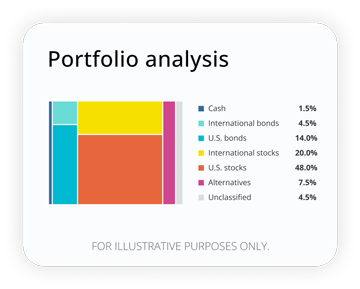
How well are your investments performing?
Analyze your portfolio in minutes and receive a target allocation for your goals.
Getting tax records in a row
There may be good reasons to wait to file. Documents are often staggered: The IRS requires employers to distribute W-2s by the end of January, but brokerage firms and investment firms may take much longer to reconcile records and send out forms. For example, the following forms must be mailed to you by February 17, 2026:3
- Forms 1099-B (broker’s report of investment sale proceeds)
- 1099-DA (crypto and digital asset sale proceeds)
- 1099-S (real estate exchange or sale proceeds)
- 1099-MISC (rents, royalties, prizes)
- 1099-NEC (independent contractor payments)
- Consolidated 1099s (1099-INT, 1099-DIV, 1099-B, and others rolled up by investment firms)
Because funds and issuers often finalize the tax character of year-end payouts after the calendar closes (for example, whether a payment is a qualified dividend, ordinary dividend, capital-gain distribution, or return of capital), financial institutions sometimes can’t lock in the numbers right away.4 That’s why some firms deliver consolidated 1099s in February and may follow up with a corrected version if classifications change.5
Get ready — but hold steady — on filing
Having W-2s is just the start. Taking a “wait-and-see” approach to filing may be a wise strategy before getting every financial statement, rather than attempting to forge on without finalized versions. For example, firms may release an initial version of a document, only to follow it with a "Corrected 1099" weeks later.6
Hitting submit on your tax return before corrections are available may lead to the need for amended return. These returns, called 1040-X, may take 8 to 12 weeks to process.7 In some cases, they can take up to 16 weeks.
Use your history as a blueprint
Past practice may be precedent with regard to tax forms. Unless there’s been an employment change, the sale of major assets, or other major life or financial events, last year’s returns may offer a glimpse into what awaits this year.8 A quick ten-minute review of last year’s 1040 and its accompanying schedules could be a useful reminder of financial holdings that may not stand out otherwise.9 Think high-yield savings accounts, certificates of deposit (CDs), or recurring charitable contributions.
This preparation phase can also be an ideal time to flag major life changes that might alter documents. Switching jobs, selling a primary residence, or moving to a new state could require specific forms, such as closing disclosures or a 1099-G that a standard W-2 won't cover.10,11 Making note of these changes help prevent last-minute searches for paperwork that may stall the filing process in April.
Tax preparation checklist
People may rely on a physical or digital folder to collect documents as they arrive, but these folders are passive tools that don’t reveal what might be missing. Creating a checklist that includes expected forms and their sources might be helpful. A robust checklist could include:
- Income streams: Wages, contractor payments (1099-NEC), and unemployment.12
- Investment activity: Interest, dividends, and capital gains.
- Retirement and health: HSA contributions, 1099-R distributions, and student loan interest.
- Education and housing: Mortgage interest statements (1098) and tuition forms.
A list of deduction-related forms could also be helpful. This could consist of:
- Charitable giving: Form 8283 for non-cash donations over $500.13
- Medical out-of-pocket expenses: Receipts and statements that support deductible medical and dental expenses, if itemizing on a return.14
- State/local taxes (SALT): W-2 withholding info, property tax bills/receipts, and Form 1099-G for certain government payments (like some state tax refunds/unemployment).15
- Homeownership interest: Form 1098 for mortgage interest.16
- Education: Form 1098-E (student loan interest) and Form 1098-T (tuition statement).17
- Health savings accounts: Form 5498-SA (health savings account (HSA) contributions) and Form 1099-SA (HSA distributions).
- IRA contributions: Form 5498.
This list also helps identify potential friction points early, in case needed forms are missing. Since a significant number of tax documents now live behind secure portals that require multi-factor authentication or updated credentials, a tune-up may help provide lead time to reset passwords and verify digital access before tax deadlines get closer.
The two-session workflow
A successful tune-up doesn't need to take hours. In fact, it works best when broken into two focused, high-impact sessions that keep the process manageable.
Session one (January): Getting started
The goal for this initial session is discovery. Review the previous year’s return, build a tax preparation checklist, and log into every portal to ensure your credentials still work. This stage isn’t about calculations. Rather, it’s about establishing what will be needed.
Session two (mid-February): Verification
By this point, the majority of needed tax-related documents will likely have arrived. It might be a good time to cross-reference the preparation checklist against the actual files on hand and look for any discrepancies. A tax filer that’s received corrected forms from a financial institutions in the past, might prefer to wait a few weeks before filing. This second tune-up session may serve as a green light for the actual filing process.
Preparing for the tax season ahead An early tune-up is not about speed — it is about control. Treating the first few weeks of the year as a diagnostic period can help reduce anxieties about filing while also potentially reducing the risk of refiling.
When taxpayers file electronically and choose direct deposit, refunds are often issued in less than 21 days — so long as there are no issues with the return. Non-electronic payments may take six weeks or longer for refunds sent by mail.17
Organizing before sitting down to tackle taxes can help take some of the logistical challenges out of the process. Knowing how to login to accounts, understanding where documents are, and getting an impression of what to expect based on the prior year’s return may all help provide a clearer view of your overall financial health and what tax time might have in store.
1 IRS “IRS reminder: Wage statements and certain information returns due by Jan. 31,” January 2025
2 CNBC, “Bigger tax refunds are coming for 2026 — what it could mean for the economy,” January 2026.
3 IRS, “General Instructions for Certain Information Returns (2025),” Accessed January 2026
4 IRS, “Mutual funds (costs, distributions, etc.),” Accessed January 2026
5 IRS, “General Instructions for Certain Information Returns (2025),” Accessed January 2026
6 Ibid
7 IRS, “Where’s My Amended Return?” Accessed January 2026
8 IRS, “Managing your tax records after you have filed,” Accessed January 2026
9 IRS, “Taxpayers can request a copy of previous tax returns,” Accessed January 2026
10 IRS, “About Form W-2, Wage and Tax Statement,” Accessed January 2026
11 IRS, “About Form 1099-S, Proceeds from Real Estate Transactions,” Accessed January 2026
12 IRS, “IRS reminder: Wage statements and certain information returns due by Jan. 31,” January 2025
13 IRS, “Substantiating charitable contributions,” January 2025
14 IRS, “Topic no. 502, Medical and dental expenses,” January 2025
15 IRS, “Topic no. 503, Deductible taxes,” Accessed January 2026
16 IRS, “About Form 1098-E, Student Loan Interest Statement,” Accessed January 2026
17 IRS to phase out paper tax refund checks starting with individual taxpayers
RO5124983-0126
 Get The Currency newsletter



The Currency editors
Staff contributors
The CurrencyTM writers and editors cover the latest financial news and insights shaping how we live, work, and play. The team provides accurate, data-driven, and timely content aimed at empowering financial freedom for all.
The content contained in this blog post is intended for general informational purposes only and is not meant to constitute legal, tax, accounting or investment advice. You should consult a qualified legal or tax professional regarding your specific situation. No part of this blog, nor the links contained therein is a solicitation or offer to sell securities. Compensation for freelance contributions not to exceed $1,250. Third-party data is obtained from sources believed to be reliable; however, Empower cannot guarantee the accuracy, timeliness, completeness or fitness of this data for any particular purpose. Third-party links are provided solely as a convenience and do not imply an affiliation, endorsement or approval by Empower of the contents on such third-party websites. This article is based on current events, research, and developments at the time of publication, which may change over time.
Certain sections of this blog may contain forward-looking statements that are based on our reasonable expectations, estimates, projections and assumptions. Past performance is not a guarantee of future return, nor is it indicative of future performance. Investing involves risk. The value of your investment will fluctuate and you may lose money.
Certified Financial Planner Board of Standards Inc. (CFP Board) owns the certification marks CFP®, CERTIFIED FINANCIAL PLANNER™, CFP® (with plaque design), and CFP® (with flame design) in the U.S., which it authorizes use of by individuals who successfully complete CFP Board's initial and ongoing certification requirements.