

10 financial resolutions for 2026
10 financial resolutions for 2026
A new year’s resolution can benefit your wallet and wealth by bringing money topics into the spotlight
10 financial resolutions for 2026
A new year’s resolution can benefit your wallet and wealth by bringing money topics into the spotlight

12.11.2025
Key takeaways
- Monitoring spending and building an emergency fund support financial stability
- Assess progress on goals by tracking net worth
- Having a digital estate plan and a will can prepare for the future before it’s needed
Empower findings show that 30% of Americans set money goals before the year ends. These ideas can help people stay aligned with long-term savings throughout 2026.
If you're giving a little more thought into how to reach your goals at the start of the new year, you're not alone. Empower research found that around a third of Americans set financial goals or resolutions for 2026 and create a financial plan (30%) at year’s end. Ready to commit to setting 2026 financial goals but need a little inspiration? Here are 10 New Year’s financial resolutions to spark ideas:
1. Meet your match
If you’re able, meeting your company match in your workplace retirement account is generally a good idea. There’s a reason a 401(k) match is often referred to as “free money.” You don’t have to do anything to earn it other than contribute to your retirement plan; if your retirement plan offers a match and you contribute to your 401(k), your employer also contributes funds. Many companies will typically match 50% or 100% of your contributions up to a certain percentage of your salary.
A good goal may be to contribute the minimum amount required to take full advantage of your company match – and adjustments can be made to contribute more later on.
2. Raise your retirement contribution rate
Maybe you’re already meeting your employer match amount, or you’re looking to kick up your retirement savings a notch. Contributing 10% (or even more) to your retirement plan account can be another way to jumpstart savings. And while your take-home pay will be reduced, your taxable income is also reduced if you contribute on a pre-tax basis, and your retirement nest egg has the potential to grow. For 2026, people can defer up to $24,500 in a workplace retirement plan, and there are additional catch-up contribution amounts available for savers 50 and older.
And if you're already maximizing your employer plan contributions, or don't have access to an employer plan, consider contributing to an individual retirement account.
Read more: Can I contribute to a 401(k) and an IRA?
3. Pay off personal debt
Determining how to pay off debt depends on what type of debt you have. Empower findings show that a quarter of people who carry a credit card balance owe $10,000 or more. Ensuring you understand the ins and outs of credit cards and consulting a debt payoff calculator can be a good ways to start brainstorming a plan.
Read more: 5 terms to know to use credit cards responsibly
4. Keep track of expenses
Maybe it’s a daily barista-made coffee, a premium streaming subscription or that afternoon sweet treat. Even small expenses add up and can contribute to lifestyle creep. Try to balance any new changes in spending with additional money being set aside for savings — such as in a tax-advantaged account — to keep potentially growing your nest egg. Setting an “ambitious budget” for each month could also help reduce spending by around 22%.
5. Build an emergency fund
Cars can break down, basements flood, and injuries happen. While people may not expect the unexpected, planning ahead to create an emergency fund can help cover unforeseen expenses when the need arises.
6. Consider a financial professional
Some 20% of Americans consult a financial professional at the end of the year, according to Empower research. A financial professional can help determine financial goals, lay out different options, and provide a personalized plan.
7. Protect your digital life
With life happening increasingly more online and connected, people now juggle an average of 168 passwords. Thinking about important information, logins for financial institutions and email may come to mind, though it’s important to take stock of your entire digital life to protect yourself from fraud. Creating a secure list (with the help of a password manager or other method) can help prevent forgetting or reusing passwords and needing to reset them.
8. Calculate your net worth
Knowing your net worth gives you a big-picture view of your financial health at a given time, and being able to track it can be effective to see if your finances are on track toward your goals. People also see their average net worth shift over time, with general increases from their 20s through their 60s and then easing off in retirement.
9. Write a will
A will may help ensure your final wishes are carried out as you intend. Without one in place, your transfer of assets may be subject to a lengthy process known as probate, which involves the courts dictating how your wealth is distributed.
10. Make a financial plan
Regardless of whether you’re early in your career or nearing retirement, it pays to preserve savings for your future self. Writing down your short-term and long-term financial goals may help you make progress toward the future you imagine.
Money goals for 2026 and beyond
To keep going strong all year long, it helps to set money goals that are:
Specific: Be precise. Instead of saying, “My New Year’s resolution is to save money,” put an actual number on it. If you want to set aside more into your 401(k) or IRA account, determine an exact value like a 10% contribution rate.
Attainable: Be practical. Consider your daily habits, ongoing expenses, and estimate from there. Establish reasonable expectations that fit with your income or salary.
Durable: Be persistent. Life can throw curve balls, though Americans have shown resilience through changing job markets and inflation. Goals can be a grounding force even if timelines have to change.
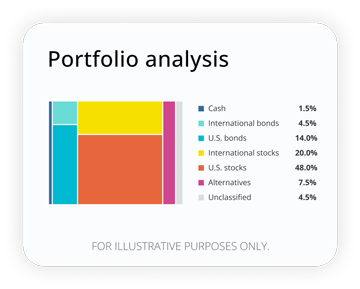
How well are your investments performing?
Analyze your portfolio in minutes and receive a target allocation for your goals.
RO5056473-1225
 Get The Currency newsletter



The Currency editors
Staff contributors
The CurrencyTM writers and editors cover the latest financial news and insights shaping how we live, work, and play. The team provides accurate, data-driven, and timely content aimed at empowering financial freedom for all.
The content contained in this blog post is intended for general informational purposes only and is not meant to constitute legal, tax, accounting or investment advice. You should consult a qualified legal or tax professional regarding your specific situation. No part of this blog, nor the links contained therein is a solicitation or offer to sell securities. Compensation for freelance contributions not to exceed $1,250. Third-party data is obtained from sources believed to be reliable; however, Empower cannot guarantee the accuracy, timeliness, completeness or fitness of this data for any particular purpose. Third-party links are provided solely as a convenience and do not imply an affiliation, endorsement or approval by Empower of the contents on such third-party websites. This article is based on current events, research, and developments at the time of publication, which may change over time.
Certain sections of this blog may contain forward-looking statements that are based on our reasonable expectations, estimates, projections and assumptions. Past performance is not a guarantee of future return, nor is it indicative of future performance. Investing involves risk. The value of your investment will fluctuate and you may lose money.
Certified Financial Planner Board of Standards Inc. (CFP Board) owns the certification marks CFP®, CERTIFIED FINANCIAL PLANNER™, CFP® (with plaque design), and CFP® (with flame design) in the U.S., which it authorizes use of by individuals who successfully complete CFP Board's initial and ongoing certification requirements.