

Which states don’t tax retirement income?
Which states don’t tax retirement income?
State tax policies can shape retirement budgets. Compare income, pension, and Social Security tax rules across the U.S. in 2026
Which states don’t tax retirement income?
State tax policies can shape retirement budgets. Compare income, pension, and Social Security tax rules across the U.S. in 2026

02.27.2026
Key takeaways
- Eight U.S. states levy no individual income tax
- Retirement income tax rules differ widely across states
- Property and sales taxes also affect retirees’ budgets
- Tax policies shift; updated research is essential
Some U.S. states do not tax retirement income, while others tax pensions, 401(k) withdrawals, or Social Security benefits. In 2026, eight states have no income tax, and nine states tax Social Security. Retirees should also weigh property and sales taxes when considering relocation. Tax rules change, so review state laws regularly.
Most retirement savers tend to focus on how much money they’re putting away for retirement and how much their investments are earning. These are certainly important factors when it comes to planning for a financially comfortable retirement.
But there’s another critical — and often overlooked— factor that’s just as important: taxes. Different states tax retirement, pension, and Social Security income differently. There are also big differences in how states assess sales and use taxes and how localities assess sales and property taxes, especially on residential real estate.
These differences in taxation could have a big impact on your retirement finances, especially when it comes to how long your retirement nest egg lasts. So, it’s a good idea to do some research into state taxation before deciding where you’ll spend your retirement years.
Read more: Best U.S. states to retire in 2026
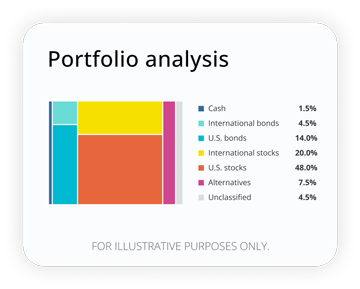
How well are your investments performing?
Analyze your portfolio in minutes and receive a target allocation for your goals.
States with no individual income tax
There are currently eight states in which individual income is not subject to tax: Alaska, Florida, Nevada, New Hampshire, South Dakota, Tennessee, Texas, and Wyoming.1
State taxation of retirement income differs significantly across the U.S. Some states completely exclude retirement earnings from taxes, while others apply varying levels of taxation to pension payments, IRA and 401(k) withdrawals, military retirement pay, and Social Security benefits.2
Along with the states above with no income tax at all, four states with state income tax exempt retirement income:3
- Illinois
- Iowa
- Mississippi
- Pennsylvania
The state income tax rate is another important consideration. The national weighted average combined sales tax rate is 7.53%, and Louisiana (10.11%), Tennessee (9.61%), Washington (9.51%), Arkansas (9.46%), and Alabama (9.46%) have the highest average combined state and local sales tax rates in the U.S.4
Which states tax social security income?
Meanwhile, eight states tax Social Security income:5
- Colorado
- Connecticut
- Minnesota
- Montana
- New Mexico
- Rhode Island
- Utah
- Vermont
West Virginia taxed Social Security benefits through 2025 and is phasing out this taxation beginning in 2026; 65% of benefits will be tax-exempt for 2025 returns filed in 2026, and benefits will be completely exempt from its state tax for 2026 returns filed in 2027.6
Some of these states that tax Social Security income provide tax breaks for low-income couples and individuals.
The role of sales taxes in retirement
State income taxes aren’t the only taxes that can affect your income in retirement. State sales and local sales and use taxes can also take a bite out of your retirement finances. All states and the District of Columbia impose these taxes except Alaska, Delaware, Montana, New Hampshire and Oregon.7
The highest state sales taxes in 2026 are in California (7.25%), Indiana, Mississippi, Rhode Island, and Tennessee (7.0% in each).8 On the flip side, the lowest state sales taxes are in Colorado (2.9%), Alabama, Georgia, Hawaii, New York, and Wyoming (4.0% in each).9 Local sales and use taxes, meanwhile, are assessed by cities, counties and special taxing jurisdictions. These vary widely across the country.
Read more: 2025 and 2026 tax brackets: New thresholds, same rates, paycheck impact
Property taxes in retirement
State and local property taxes are another important factor to consider. The biggest property tax paid by most retirees is the annual tax paid on the value of their home. However, some states and local jurisdictions offer property tax exemptions, credits and abatements to retirees, such as an exemption from paying the school tax portion of their property taxes.10
Additional considerations
Retirement tax planning can be complicated, and the details vary from one individual or couple to the next. It may be a good idea to work with a tax professional or consult a financial professional for guidance in your specific situation.
Read more: Beyond tax season: Why year-round tax planning can pay off
Frequently asked questions about state retirement taxes
Which states have no state income tax at all?
As of 2026, Alaska, Florida, Nevada, New Hampshire, South Dakota, Tennessee, Texas, and Wyoming.
Do any states still tax Social Security benefits?
Yes. Nine states tax Social Security benefits, but West Virginia is phasing out this tax in 2026.
How do property taxes affect retirees?
Property taxes vary by state and county. Some states offer credits or exemptions for older adults to reduce the burden.
Are sales taxes important for retirees?
Yes. High sales taxes in certain states can significantly affect retirement budgets.
How do cost of living and taxes interact in retirement?
Low or no-income tax states may still have high property, housing, or healthcare costs. Retirees often weigh overall affordability — not just state tax policy — when deciding where to live.
1 Tax Foundation, State Individual Income Tax Rates and Brackets, 2026,” February 17, 2026.
2 CNBC, “These 13 states don’t tax Social Security, 401(k) accounts, IRAs or pensions,” February 11, 2026.
3 Ibid.
4 Tax Foundation, “State and Local Sales Tax Rates, 2026,” January 20, 2026.
5 CNBC, “These 13 states don’t tax Social Security, 401(k) accounts, IRAs or pensions,” February 11, 2026.
6 Ibid.
7 Tax Foundation, “What states have no sales tax?” March 27, 2025.
8 Tax Foundation, “State and Local Sales Tax Rates, 2026,” January 20, 2026.
9 Ibid.
10 AARP, “Get Help Applying for a Property Tax Credit or Refund,” accessed February 2026.
RO5249726-0226
 Get The Currency newsletter



The Currency editors
Staff contributors
The CurrencyTM writers and editors cover the latest financial news and insights shaping how we live, work, and play. The team provides accurate, data-driven, and timely content aimed at empowering financial freedom for all.
The content contained in this blog post is intended for general informational purposes only and is not meant to constitute legal, tax, accounting or investment advice. You should consult a qualified legal or tax professional regarding your specific situation. No part of this blog, nor the links contained therein is a solicitation or offer to sell securities. Compensation for freelance contributions not to exceed $1,250. Third-party data is obtained from sources believed to be reliable; however, Empower cannot guarantee the accuracy, timeliness, completeness or fitness of this data for any particular purpose. Third-party links are provided solely as a convenience and do not imply an affiliation, endorsement or approval by Empower of the contents on such third-party websites. This article is based on current events, research, and developments at the time of publication, which may change over time.
Certain sections of this blog may contain forward-looking statements that are based on our reasonable expectations, estimates, projections and assumptions. Past performance is not a guarantee of future return, nor is it indicative of future performance. Investing involves risk. The value of your investment will fluctuate and you may lose money.
Certified Financial Planner Board of Standards Inc. (CFP Board) owns the certification marks CFP®, CERTIFIED FINANCIAL PLANNER™, CFP® (with plaque design), and CFP® (with flame design) in the U.S., which it authorizes use of by individuals who successfully complete CFP Board's initial and ongoing certification requirements.