

The Retirement Drift

1 in 3 Americans have lost track of retirement savings from a previous job
New job. Old 401(k). A new study from Empower finds that as Americans move from job to job, retirement savings don’t always move with them, leaving money behind along the way.

Executive summary
A career change can signal an exciting opportunity, the start of a new chapter, or an unexpected transition. It can also leave something behind: a retirement account.
A new study from Empower finds that 84% of Americans have changed employers at least once during their careers, more than half have changed employers three or more times (53%), and more than a quarter have made at least five moves (27%) in their working lives.
Empower uses "Retirement drift” to describe how retirement savings can become spread across accounts from different employers as people change jobs over the course of their careers, creating a more fragmented and complex financial picture that can make those savings harder to track and manage. Nearly 2 in 5 have retirement savings spread across accounts from different employers (39%), and more than half (54%) say having savings in multiple accounts makes it harder to plan for retirement.
For younger Americans, the “drift” issue is emerging early in their careers. Half of Gen Z (50%) and 45% of Millennials say they may have retirement savings from a previous employer that they have lost track of, compared with 34% of Americans overall (30% of Gen X and 14% of Boomers). And 57% of Gen Z and 45% of Millennials aren’t confident they could locate all their retirement savings today (41% overall).
With financial priorities competing for attention, visibility and simplicity stand out: 84% of Americans say keeping their retirement savings organized gives them greater peace of mind, and 83% feel more in control when those savings are organized in one place. Three-quarters say clear, step-by-step guidance would make them more likely to act (76%), while 70% would be more likely to combine old retirement accounts if the process took less time.
As careers span employers, roles, and stages of life, Americans are looking for retirement support that can go the distance: 81% want guidance that stays with them throughout their career, not just when they are employed.
Key findings from Empower's "The Retirement Drift" study:
|
What do Americans report about retirement savings across employers?
A former employer can remain part of someone’s financial life long after the job itself ends. Two in 5 (39%) Americans say their retirement savings are spread across accounts from different employers, which is one way retirement savings can begin to drift across a working life.
More than half (54%) say having savings in multiple accounts makes it harder to plan for retirement, while 45% say every job change makes managing those savings more complicated.
Yet the vast majority (85%) agree on one thing: Leaving a job shouldn’t mean starting over with retirement planning.
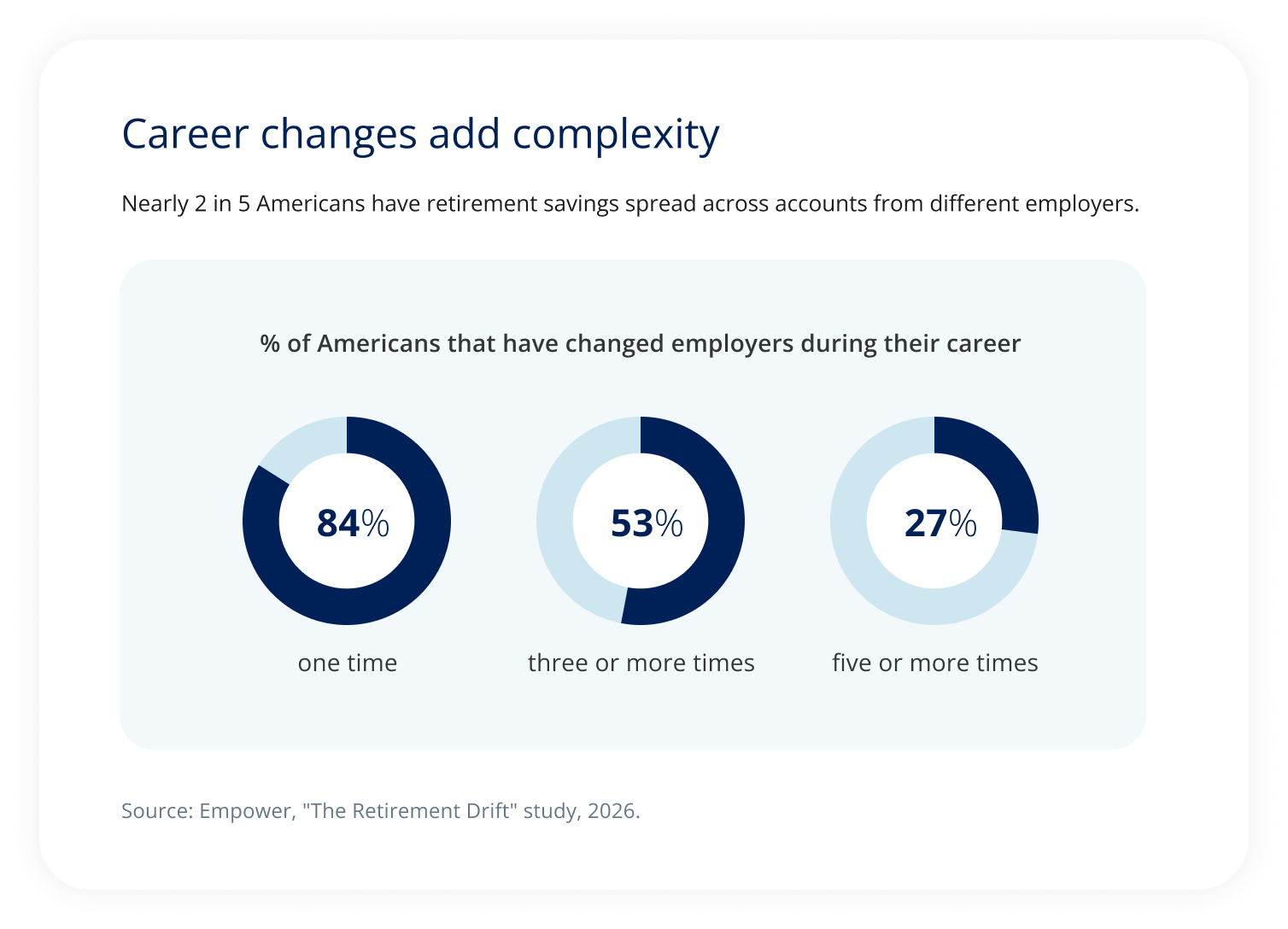
The infographic illustrates how career changes can add complexity to retirement savings. According to Empower's 2026 "The Retirement Drift" study, nearly 2 in 5 Americans have retirement savings spread across accounts from different employers.
Among Americans surveyed, 84% have changed employers at least once during their career, 53% have changed employers three or more times, and 27% have changed employers five or more times.
Key takeaway: Changing employers is common, and repeated career moves can leave individuals managing retirement savings across multiple employer-sponsored accounts.
Which generations say they may have lost track of retirement savings?
Gen Z and Millennials report some of the greatest difficulty keeping track of retirement savings. Half of Gen Z (50%) and 45% of Millennials say they may have retirement savings from a previous employer that they have lost track of, compared with 34% overall (30% Gen X; 14% of Boomers).
There’s uncertainty about what’s out there, too: 57% of Gen Z and 45% of Millennials aren’t confident they could locate all of their retirement savings today, compared with 38% of Gen X and 25% of Boomers (41% overall). More than half of Gen Z (54%) also worry they could lose track of retirement savings over the course of their careers (40% overall).
The complexity extends to managing those savings: 58% of Millennials and 54% of Gen Z say every job change makes retirement savings more complicated, compared with 45% overall.
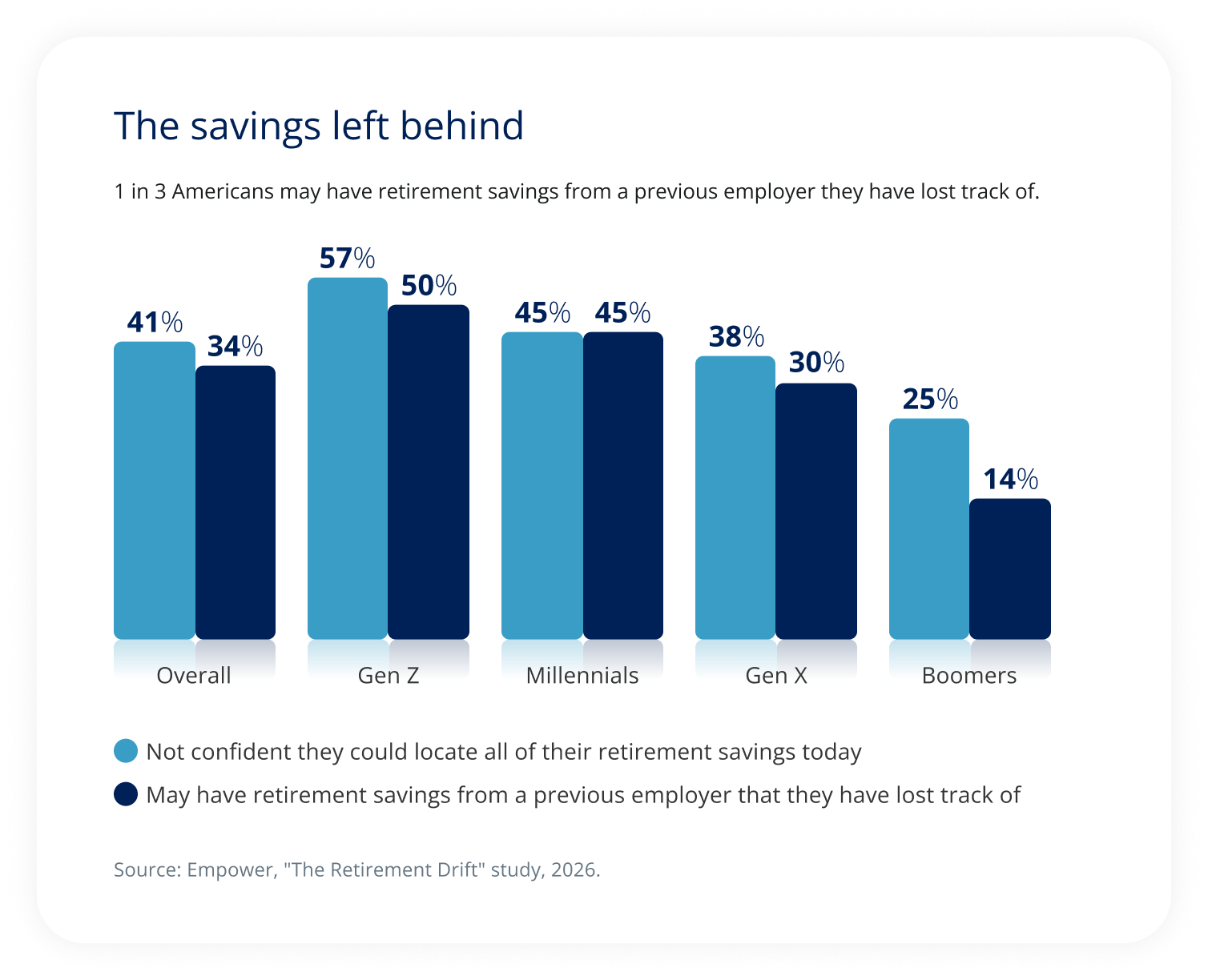
The chart compares Americans' ability to keep track of retirement savings overall and by generation. Two measures are shown: those who are not confident they could locate all of their retirement savings today, and those who may have retirement savings from a previous employer that they have lost track of.
Overall, 41% are not confident they could locate all of their retirement savings, while 34% may have lost track of retirement savings from a previous employer.
Gen Z reports the highest rates: 57% are not confident they could locate all their retirement savings, and 50% may have lost track of savings from a previous employer. Among Millennials, both measures are 45%. For Gen X, the figures are 38% and 30%, respectively. Boomers report the lowest rates, at 25% and 14%.
Key takeaway: Difficulty keeping track of retirement savings is more prevalent among younger generations. Overall, about one in three Americans may have retirement savings from a previous employer that they have lost track of.
Source: Empower, The Retirement Drift study, 2026.
Top roadblocks for Americans
Old retirement accounts can compete with more immediate financial demands. More than half of Americans (54%) say retirement planning is more confusing than other areas of personal finance, and the same percentage say managing their retirement savings often falls to the bottom of their financial to-do list, a figure that rises to 64% of Gen Z and 66% of Millennials.
Understanding the options can be another roadblock: 47% say they’ve delayed dealing with retirement savings, such as initiating a rollover, because it felt overwhelming, including 58% of Gen Z and 57% of Millennials, compared with 23% of Boomers. Over half overall (57%) said they tend to put off financial tasks that seem complicated, which was especially the case for Gen Zers (69%) and Millennials (66%).
For many, the challenge starts with knowing what to do. Two-thirds (66%) wish someone had explained their retirement savings options when they changed jobs, and 54% weren’t aware they had several options after leaving an employer. Eight in 10 (80%) say understanding their options after leaving a job would help them make better financial decisions.
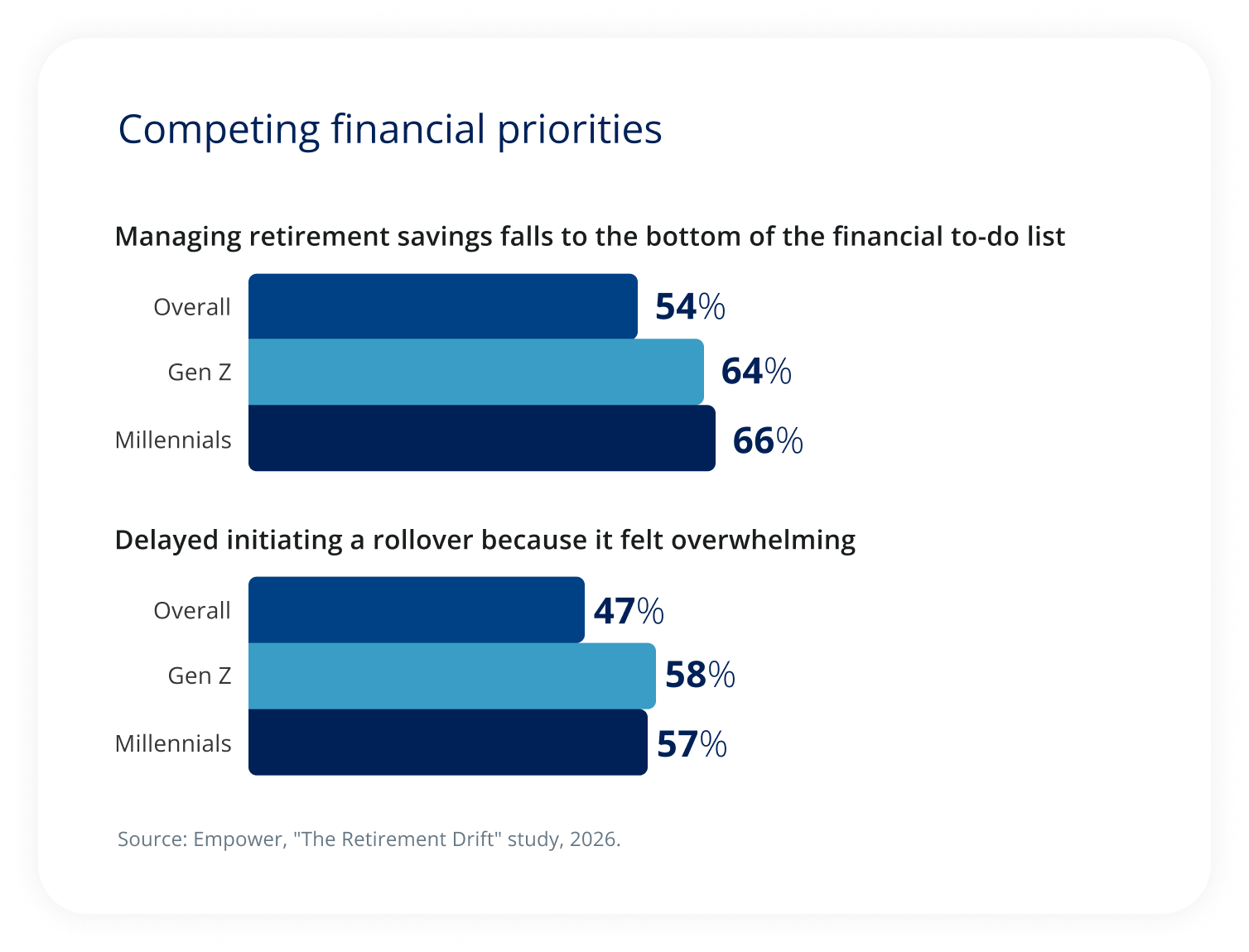
The chart compares two retirement savings challenges among Americans overall, Gen Z, and Millennials.
For managing retirement savings falling to the bottom of the financial to-do list, the figure is 54% overall, 64% for Gen Z, and 66% for Millennials.
For delaying initiation of a rollover because it felt overwhelming, the figure is 47% overall, 58% for Gen Z, and 57% for Millennials.
Key takeaway: Competing financial priorities and the perceived complexity of rollovers are common barriers to managing retirement savings, with both challenges reported more frequently by Gen Z and Millennials than by Americans overall.
Source: Empower, The Retirement Drift study, 2026.
What would help Americans take action on retirement savings?
Having a clearer view of retirement savings can bring a sense of confidence and control: 84% say keeping their retirement savings organized gives them greater peace of mind, while 83% feel more in control when those savings are organized in one place.
Simplicity also matters when it comes to action. Three-quarters (76%) say clear, step-by-step guidance would make them more likely to act, while 70% would be more likely to combine old retirement accounts if the process took less time. Another 70% say better understanding their retirement options would make them more likely to act.
And Americans are looking beyond a single decision: 81% want retirement guidance that stays with them throughout their career.
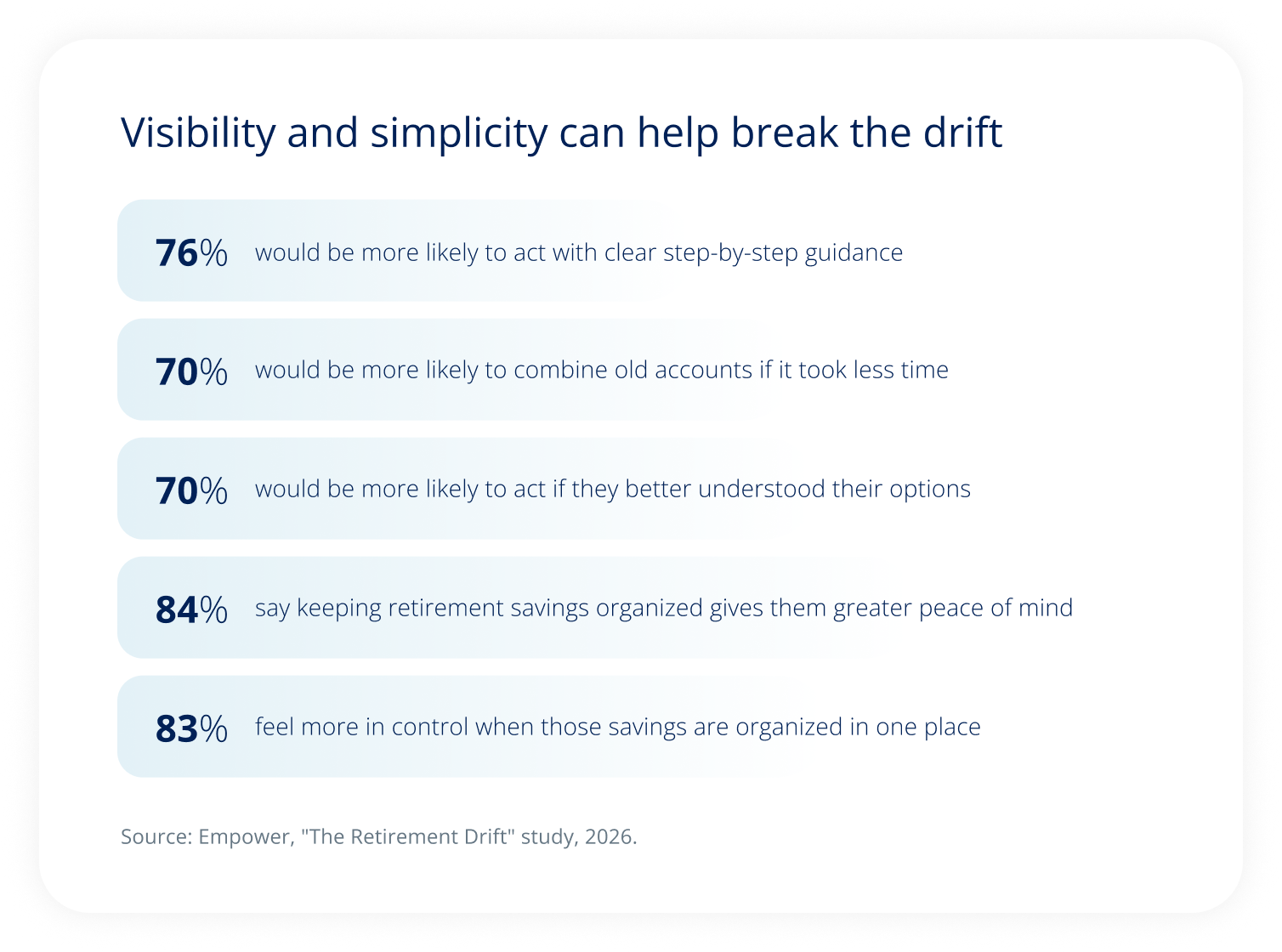
The infographic presents five findings from Empower's 2026 The Retirement Drift study about simplifying and organizing retirement savings.
76% would be more likely to act with clear step-by-step guidance. 70% would be more likely to combine old accounts if the process took less time, and 70% would be more likely to act if they better understood their options.
In addition, 84% say keeping retirement savings organized gives them greater peace of mind, while 83% feel more in control when those savings are organized in one place.
Key takeaway: Clearer guidance, better understanding of available options, a less time-consuming consolidation process, and keeping retirement savings organized may help people overcome barriers to taking action while increasing their sense of control and peace of mind.
Source: Empower, The Retirement Drift study, 2026.
Roth or traditional?
For Americans considering what to do with an old 401(k), an IRA is one option, but understanding the choices isn’t always simple.
Some 83% believe an IRA can be an important part of building long-term retirement savings, yet nearly 6 in 10 aren’t sure whether a Roth or traditional IRA is the better fit for their financial situation (59%).
Perceptions may also play a role: 53% say they had assumed IRAs were for people with more money than they had, rising to 64% among Millennials, 60% of Gen X, and 59% of Gen Z, compared with 31% of Boomers.
AI meets the financial advisor
Technology has a place in the retirement toolkit: 63% say AI and digital tools can make retirement planning easier.
But for important retirement decisions, human expertise still has the edge: 78% trust a financial professional more than AI, while 73% see AI as a complement to professional financial advice, not a replacement for human expertise.
That preference can translate into taking the necessary step as talking with a financial professional is the most selected catalyst that would prompt Americans to review or take action on their retirement savings (22%).
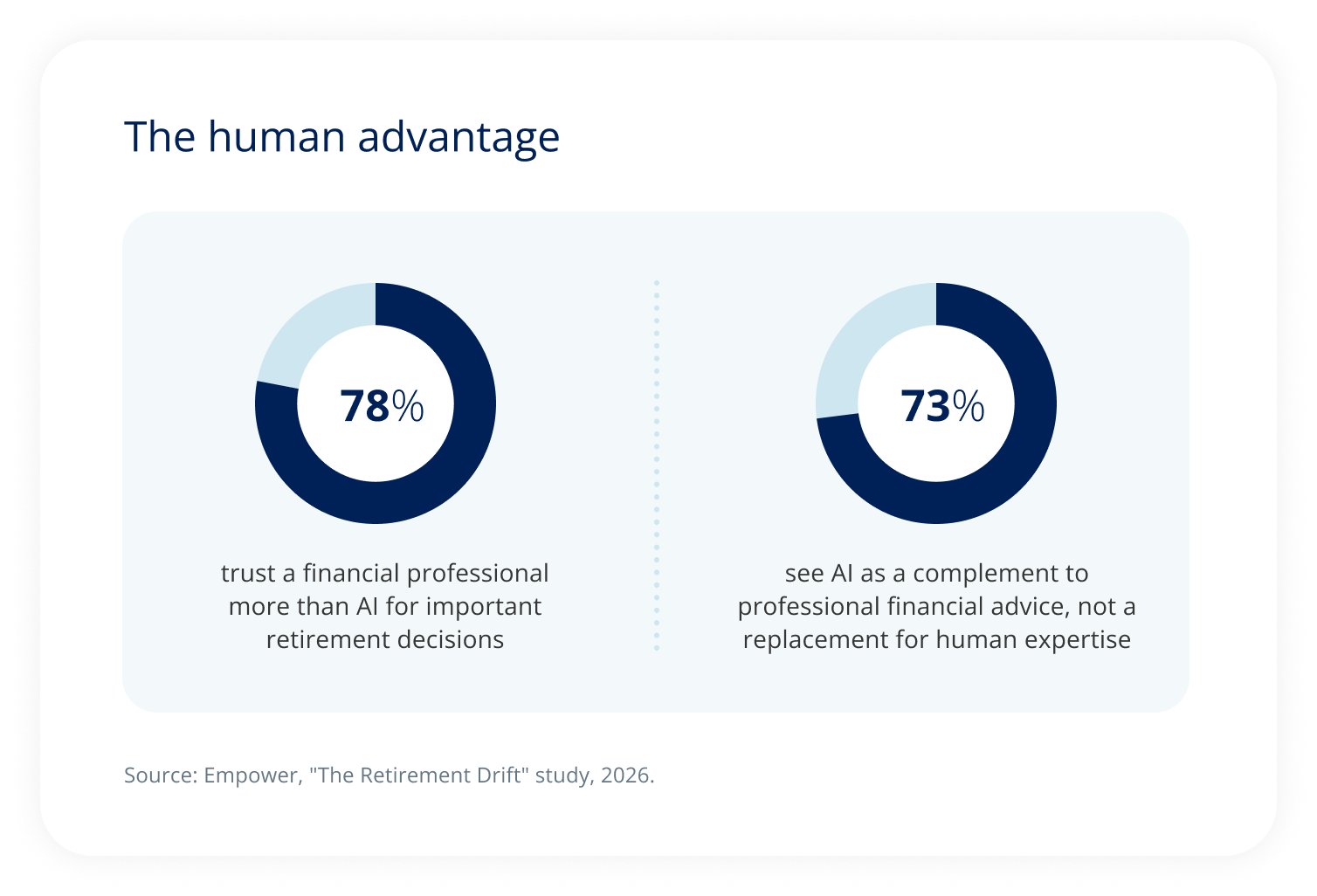
The infographic presents two findings from Empower's 2026 The Retirement Drift study about preferences for human financial expertise and artificial intelligence.
78% trust a financial professional more than AI when making important retirement decisions.
73% see AI as a complement to professional financial advice rather than a replacement for human expertise.
Key takeaway: Respondents generally favor a combination of technology and human expertise, with substantial majorities expressing greater trust in financial professionals for important retirement decisions and viewing AI as a supporting tool rather than a substitute for professional advice.
Source: Empower, The Retirement Drift study, 2026.
The bigger picture
Retirement drift can start with something ordinary: leaving one job and moving on to the next. Over a working life, old accounts can accumulate, financial priorities can compete for attention, and retirement decisions can get pushed to another day.
The research shows Americans value the opposite experience: greater visibility, less complexity, and support that can stay with them as their careers evolve.
Jobs change. Retirement planning doesn’t have to start over. Talking to a financial professional can help you learn more and better understand your options.
For more information, see Empower’s guide to 401(k) rollover options.
Methodology
Empower’s “The Retirement Drift” study is based on online survey responses from 2,005 Americans ages 18+ fielded by an independent third-party panel provider from July 30-August 1, 2026. The survey is weighted to be nationally representative of U.S. adults.
MC-WMLPNV-WF-6966050-0926 RO5950750-0926
 Be current.
Get insights and intel on your money.
*If you’re already registered with Empower, please use the same email address as your existing account.
The opinions expressed represent the current, good-faith views of Empower at the time of publication, are provided for limited purposes, and should not be relied upon as investment or legal advice.
Investing involves risk, including possible loss of principal.
Past performance, where discussed, is not a guarantee of future results. Historical trends and economic data discussed may not be indicative of future conditions which may change.
This material is for informational/educational purposes only; it may not be suitable for all investors; is not tailored to any specific investor’s objectives or financial situation; and is not intended as investment, legal, tax, or accounting advice.
This content is based on information available at the time and may change based on more current conditions. This is neither an endorsement of any security, index, sector, or investment, nor a solicitation to offer investment advice or sell products or services offered by Empower or its affiliates. It is impossible to invest directly in an index. References to asset classes or sectors are for illustrative purposes only and are not recommendations.
The information presented was developed internally and/or obtained from sources believed to be reliable; however, Empower does not guarantee the accuracy, adequacy, or completeness of such information.
Predictions, opinions, and other information contained in this communication are subject to change without notice and may no longer be true after the date indicated.
Commentary may contain forward-looking statements based on reasonable expectations, estimates, projections, and assumptions. Forward-looking statements are not guarantees of future performance and involve risks and uncertainties that are difficult to predict.
Fixed-income securities are subject to interest rate risk and inflation risk.
“EMPOWER” and all associated logos and product names are trademarks of Empower Annuity Insurance Company of America.
©2026 Empower Annuity Insurance Company of America. All rights reserved.
MC-WMLPNV-WF-6966050-0926 RO5585287-0626
The content contained in this blog post is intended for general informational purposes only and is not meant to constitute legal, tax, accounting or investment advice. You should consult a qualified legal or tax professional regarding your specific situation. No part of this blog, nor the links contained therein is a solicitation or offer to sell securities. Compensation for freelance contributions not to exceed $1,250. Third-party data is obtained from sources believed to be reliable; however, Empower cannot guarantee the accuracy, timeliness, completeness or fitness of this data for any particular purpose. Third-party links are provided solely as a convenience and do not imply an affiliation, endorsement or approval by Empower of the contents on such third-party websites. This article is based on current events, research, and developments at the time of publication, which may change over time.
Certain sections of this blog may contain forward-looking statements that are based on our reasonable expectations, estimates, projections and assumptions. Past performance is not a guarantee of future return, nor is it indicative of future performance. Investing involves risk. The value of your investment will fluctuate and you may lose money.
Certified Financial Planner Board of Standards Inc. (CFP Board) owns the certification marks CFP®, CERTIFIED FINANCIAL PLANNER™, CFP® (with plaque design), and CFP® (with flame design) in the U.S., which it authorizes use of by individuals who successfully complete CFP Board's initial and ongoing certification requirements.