

Planning ahead: Balancing saving and spending in retirement
Planning ahead: Balancing saving and spending in retirement
An effective financial plan should account for essential expenses and retirement splurges.
Planning ahead: Balancing saving and spending in retirement
An effective financial plan should account for essential expenses and retirement splurges.

08.13.2025
Key takeaways
- The typical annual retirement income in America is around $54,710 to $83,950.
- Reflecting on current lifestyle can help inform what’s important in retirement.
- Building in money for spending could make for a happier retirement.
As people accumulate retirement savings, it’s wise to understand where those dollars will go down the line.
Americans think $1.06 million is needed to retire comfortably, according to Empower research, though attitudes can shift as people enter and thrive in their retirement era.
In a late 2024 survey of American retirees (between the ages of 62 and 75), 38% said they have a “savings mindset,” while 11% said they have a “spending mindset.”1
People across age groups have been making good progress toward building retirement savings. The typical American has an average retirement savings of $491,022 as of July 2025, and people in their 60s have the most saved for retirement, with average balances close to $1.2 million.
As Americans prepare their finances to last through their golden years, it’s possible to strike a happy medium for spending and saving in retirement.
What’s the average retirement income?
Asking “Do I start with retirement income or expenses?” is a “chicken or egg” question. Both aspects are important to monitor a healthy cash flow, though people may have an easier time estimating what’s coming into the wallet compared with the limitless ways to spend.
No one can predict the future, though knowing the current family size and who might be around in retirement can calculate how many people will be contributing to the lifestyle (along with how many mouths to feed). The Census Bureau reported in 2023 that the typical annual retirement income can range from $54,710 (median amount) to $83,950 (average/mean amount). So, a monthly retirement income for a couple could be around double that.
Setting a goal for retirement income or savings can involve mapping out scenarios and being realistic with yourself. Think about personal motivators or affirmations and what you respond best to. Statements or questions that keep finance top of mind and focus on getting concrete answers can include:
- How much money do I need to retire with $200,000 a year?
- I want to be able to retire in Chicago with no debt.
- What matters to me most in my current lifestyle that I want in retirement?
- I can’t live without seeing my family twice a year, even if I have to travel.
The ideal retirement starts with a vision, and enlisting the help of a retirement calculator can be a good start in assigning numbers to those essentials.
Read more: Retirement income strategies: Get the most out of your retirement
Budgeting for retirement essentials
With a baseline understanding of what matters most in retirement and a sense of income, expenses are next in line — and the practical ones can be a hefty piece of the pie.
Housing can be a wild card in retirement — generally speaking, a good rule of thumb is to keep 30% of income going toward a rent or mortgage payment. Across the United States, home prices spiked to a record high in June, though some spots in the South that have seen drops could be attractive to those wanting to own a home in retirement.2 Taking a state-specific look at cost of living in cooling housing markets like Florida and Texas can help set housing expectations.
Read more: Can $1 million last through retirement?
Retiring may cut down on some essential work expenses — like around the daily commute and wardrobe refreshes — though there are several expenses that don’t go away once retirement arrives.
In 2024, Americans put $396 on their credit cards each month for healthcare and medical expenses, a 4.2% year-over-year increase, according to Empower Personal DashboardTM data.
Healthcare costs tend to increase as people age, and more than a quarter of adults between ages 40 and 64 have some type of medical debt.3 Keeping a financial cushion for doctor’s visits and prescriptions can help with the transition, and increasing those contributions over time — such as in a health savings account — can help the savings keep up with rising costs.
Keeping essential shopping and services nearby in retirement could also reduce transportation costs. The “one stop shop” mentality that surrounds 55+ communities can be attractive to people looking for housing, recreation, healthcare, and social space all nearby — following a growing trend of Americans wanting to age in place.
Accounting for retirement spending
Discretionary expenses in retirement are where people can start dreaming — and where a financial plan can be especially helpful. Around half of Americans 49% think enjoying a high quality of life makes for a happy retirement, according to Empower research.
Splurging on travel is popular among retirees, especially as multigenerational and family trips have caught on. With 13% of people saving their big trips until their retirement years, according to Empower research, leave open the possibility of a bigger travel itch than expected (and build in some extra funds). In 2024, older adults traveled more than ever and had anticipated taking an average of 3.6 trips — and then actually took 3.9 trips on average.4
Younger generations are getting a head start, prioritizing their future selves. Empower findings show that almost two in five Gen Zers (44%) have set a goal for a travel fund in retirement.
Thinking about retirement planning now
People today have been building up their nest eggs, as the national personal savings rate hit 4.9% in April, up from earlier in the year. Adding to an emergency savings fund and more liquid personal accounts — and using those dollars for current needs — allows dedicated, tax-advantaged retirement accounts to work harder down the line.
Right now, around $20 trillion of Baby Boomers’ assets are tied to real estate, and as more Americans have been tapping their home equity for lines of credit, reverse mortgages, and loans, these could be valuable tools later during retirement.
Time holds a lot of power when it comes to saving money and growing wealth. The impact of compounding — the ability to earn interest on interest — is especially clear when comparing how amounts have the potential to accelerate over time. Getting a sense of retirement income and expenses early on can bring clarity to retirement spending and saving — even if it’s just saving 1% more.
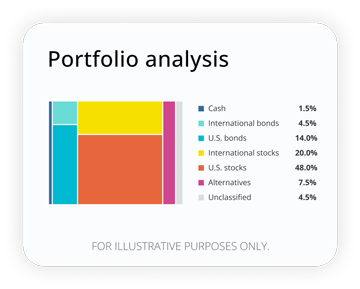
How well are your investments performing?
Analyze your portfolio in minutes and receive a target allocation for your goals.
1 Employee Benefit Research Institute, “2024 Spending in Retirement Survey,” November 2024.
2 The Wall Street Journal, “Home Prices Hit Record High in June, Dragging Down Sales,” July 2025.
3 AARP, “Health Care Affordability Is Often a Challenge for Midlife Adults,” June 2025.
4 AARP, “Older Americans Are Traveling More Than Ever, Says 2025 AARP Study,” March 2025.
RO4717879-0725
 Get The Currency newsletter



The Currency editors
Staff contributors
The CurrencyTM writers and editors cover the latest financial news and insights shaping how we live, work, and play. The team provides accurate, data-driven, and timely content aimed at empowering financial freedom for all.
The content contained in this blog post is intended for general informational purposes only and is not meant to constitute legal, tax, accounting or investment advice. You should consult a qualified legal or tax professional regarding your specific situation. No part of this blog, nor the links contained therein is a solicitation or offer to sell securities. Compensation for freelance contributions not to exceed $1,250. Third-party data is obtained from sources believed to be reliable; however, Empower cannot guarantee the accuracy, timeliness, completeness or fitness of this data for any particular purpose. Third-party links are provided solely as a convenience and do not imply an affiliation, endorsement or approval by Empower of the contents on such third-party websites. This article is based on current events, research, and developments at the time of publication, which may change over time.
Certain sections of this blog may contain forward-looking statements that are based on our reasonable expectations, estimates, projections and assumptions. Past performance is not a guarantee of future return, nor is it indicative of future performance. Investing involves risk. The value of your investment will fluctuate and you may lose money.
Certified Financial Planner Board of Standards Inc. (CFP Board) owns the certification marks CFP®, CERTIFIED FINANCIAL PLANNER™, CFP® (with plaque design), and CFP® (with flame design) in the U.S., which it authorizes use of by individuals who successfully complete CFP Board's initial and ongoing certification requirements.