

Teaching kids about money: What today's parents are doing differently
Teaching kids about money: What today's parents are doing differently
More than half of Gen Alpha's parents are already teaching kids about money — including spending, saving, and budgeting — often before age 4
Teaching kids about money: What today's parents are doing differently
More than half of Gen Alpha's parents are already teaching kids about money — including spending, saving, and budgeting — often before age 4

04.06.2026
Key takeaways
- Teaching kids about money is becoming more intentional, with parents introducing financial concepts through everyday moments and conversations at home.
- Parents are taking a hands-on approach, using allowances, real-life spending decisions, and even investing tools to build financial skills early.
- Today’s money lessons go beyond cash, as kids navigate digital payments, online earning, and even concepts like cryptocurrency.
Teaching kids about money starts at the kitchen table
Teaching kids about money is becoming a top priority for today’s parents — and it’s happening earlier than ever.
Empower research shows that two thirds of American adults never learned about personal finance in school and half say that money wasn’t discussed at home. Now, many parents are determined to change that by building financial literacy for kids from a young age.
According to a survey of 2,000 Gen Alpha parents — 70% of them Millennials — teaching children about financial responsibility is being introduced as early as they learn their ABCs and 123s. More than half of parents have already chatted with their child about spending, saving, and budgeting, and different types of money like cash and credit, often before age 4.
Some parents have also opened CD accounts, money market accounts, or a Roth IRA for their kids.1 The goal: teaching kids about money early so they can build strong financial habits for life.
Read more: 5 building blocks of financial literacy
Raising mini-money managers
Anticipated to be the largest generation yet, Gen Alpha is expected to have the greatest spending power in history: By 2029, their economic footprint is estimated to reach more than $5.46 trillion.2
To prepare, parents are taking a more proactive approach to teaching kids about money. A 2024 study found parents are currently creating an investment strategy with their child (41%), sharing logins so they can make online purchases (39%), and sharing a finance app (37%) — giving them early exposure to digital payments and how money moves online.3
At the same time, teens are finding their own ways to build financial literacy, learning through state-level courses, non-profit programs, and social media. Some teens are even starting investment portfolios before they graduate high school.
Read more: Teens take financial literacy into their own hands
How to teach kids about money at any age
When it comes to how to teach kids about money, the basics still apply: spend wisely, save consistently, and invest thoughtfully. But the approach can evolve as children grow.
Here are a few foundational strategies for teaching kids about money:
1. Explain the value of money and where it comes from
Money can bring freedom and responsibility. Helping kids understand where money comes from is the first step in financial literacy for kids. Providing a regular allowance for completing chores can help children develop a strong work ethic and begin to understand how to make choices about spending and saving.
2. Teach budgeting early
Once children have some money to manage, parents can consider introducing how budgeting works. As kids start spending and perhaps set their sights on a purchase that exceeds their allowance, parents can introduce the idea of setting aside a certain portion of their hard-earned money to save for the long run.
3. Introduce investing basics
When to introduce the basics of investing will likely depend on when an individual child has a good understanding of the foundations of spending and saving. Opening a custodial account can help kids see how money can grow over time and build early confidence in managing finances. Some parents may also explore newer options designed specifically for kids, such as Trump accounts, which aim to introduce long-term saving and investing concepts early.
4. Teach how digital payments work
As cash becomes less common, teaching kids about digital payments is an important part of financial literacy.4
Many parents are unsure how to explain digital payments to their kids, as money has shifted from something physical to something that moves invisibly online. At the same time, kids are increasingly earning and spending money in digital ways. Half of Gen Alpha kids have made money by selling items they no longer use — often online — while 38% have earned income through content creation, streaming, or influencing.5
Parents can explain how credit cards, debit cards, and mobile payments work — including how money is transferred, how to track spending, and how to stay safe online. For older kids, this can also be an opportunity to introduce emerging forms of digital money, like cryptocurrencies, at a high level — focusing on concepts like volatility, security, and long-term risk.6
5. Keep money lessons fun and practical
Teaching kids about money doesn’t have to feel like a lesson. Incorporating financial education into daily life is a great way to keep kids engaged in learning about money — be it at the grocery store, when they ask for a new toy, or as parents make their own financial decisions. How to teach kids about money may look a little different from family to family. Still, having open conversations about money and modeling positive habits can be key to setting children up for success with financial responsibility.
Why teaching kids about money matters more than ever
Professionals suggest that what parents do is just as important as what they say to kids about money: Avoiding money talks with children could mean they may pick up unintended messages and adopt less-than-desirable habits.7
Giving children some financial responsibility — in the form of an allowance, for example — is one common way that today’s parents are creating opportunities for learning and conversation.
More than two-in-five of Gen Alpha’s parents give their kids an allowance, and around half of those say their kids can spend some of their own money without parental restrictions.8 The going rate for a weekly allowance is $45 a week on average, according to one study.9
About one in three little Gen Alphas earn money through online selling or reselling, and almost half (47%) do odd jobs outside the home such as babysitting. Most commonly, they’re getting paid to do chores (69%), or as a reward for good behavior or grades (73%).10
Parents want help teaching kids about money
Despite their own economic concerns, most (77%) of Gen Alpha’s parents are very or somewhat confident in their child’s future financial security.11 But that’s not to say they wouldn’t welcome more help for building financial literacy in their kids.
Only 22% of parents are “completely confident” in their ability to teach their children the basics of investing and they’re looking to their kids’ schools for help. All else being equal, 74% of parents said they would move their children to a different school if it offered financial education and investment courses.12
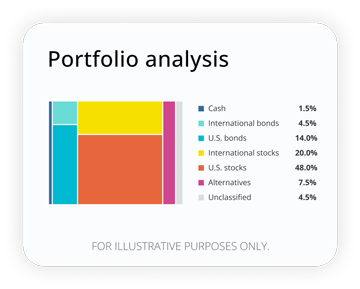
How well are your investments performing?
Analyze your portfolio in minutes and receive a target allocation for your goals.
1 Fortune, “Recession-blighted millennial parents are trying to raise their ‘Gen Alpha’ kids with the one thing they never had,” March 2023.
2 Harvard Business Review, “The Business Case for Understanding Generation Alpha,” April 2025.
3 DKC, “A Guide to Gen Alpha Insights on the Gateway Generation,” May 2024.
4 Fortune, “More than half of Gen Z says they only use cash as ‘a last resort’ and doing so is ‘cringe,’ survey shows,” November 2025.
5 Bloomberg, “How to Teach Gen Alpha Kids About Money in a Digital World,” February 2026.
6 Ibid.
7 Salon, “What are you unintentionally teaching your kids about money?” October 2024.
8 Morning Consult, “Gen Alphas Already Exhibit Strong Buying Power Across Several Categories,” April 2025.
9 DKC, “A Guide to Gen Alpha Insights on the Gateway Generation,” May 2024.
10 Ibid.
11 Fortune, “Recession-blighted millennial parents are trying to raise their ‘Gen Alpha’ kids with the one thing they never had,” March 2023.
12 CNBC, “Parents are not confident they can teach kids about investing. Here’s how advisors say to get started,” November 2024.
RO5358141-0426
 Get The Currency newsletter



The Currency editors
Staff contributors
The CurrencyTM writers and editors cover the latest financial news and insights shaping how we live, work, and play. The team provides accurate, data-driven, and timely content aimed at empowering financial freedom for all.
The content contained in this blog post is intended for general informational purposes only and is not meant to constitute legal, tax, accounting or investment advice. You should consult a qualified legal or tax professional regarding your specific situation. No part of this blog, nor the links contained therein is a solicitation or offer to sell securities. Compensation for freelance contributions not to exceed $1,250. Third-party data is obtained from sources believed to be reliable; however, Empower cannot guarantee the accuracy, timeliness, completeness or fitness of this data for any particular purpose. Third-party links are provided solely as a convenience and do not imply an affiliation, endorsement or approval by Empower of the contents on such third-party websites. This article is based on current events, research, and developments at the time of publication, which may change over time.
Certain sections of this blog may contain forward-looking statements that are based on our reasonable expectations, estimates, projections and assumptions. Past performance is not a guarantee of future return, nor is it indicative of future performance. Investing involves risk. The value of your investment will fluctuate and you may lose money.
Certified Financial Planner Board of Standards Inc. (CFP Board) owns the certification marks CFP®, CERTIFIED FINANCIAL PLANNER™, CFP® (with plaque design), and CFP® (with flame design) in the U.S., which it authorizes use of by individuals who successfully complete CFP Board's initial and ongoing certification requirements.