

The Backpack Economy: Millennials will spend nearly $400 on back-to-school
The Backpack Economy: Millennials will spend nearly $400 on back-to-school
With pencils sharpened and backpacks zipped, American families head back to school facing rising prices. Half (50%) say back-to-school shopping is more expensive this year due to inflation and rising prices (57% Gen Z and 61% Millennials).
With pencils sharpened and backpacks zipped, American families head back to school facing rising prices. Half (50%) say back-to-school shopping is more expensive this year due to inflation and rising prices (57% Gen Z and 61% Millennials).
Key takeaways
- Millennials are spending big: Average back-to-school spend reaches $394 for Millennials (and $188 for all adults, on average).
- Learning curve: Half (50%) say back-to-school shopping is more expensive this year due to inflation and rising prices (57% Gen Z, 61% Millennials). Over a third (35%) say they are spending more on back-to-school this year than last (45% Gen Z, 48% Millennials).
- Stress test: One third of Americans (31%) are stressed about back-to-school spending, rising to 43% for Millennials and Gen Z.
- T for tariffs: 39% say tariffs have made back-to-school supplies more expensive.
- Early birds: 34% of shoppers are starting earlier to spread out costs; 48% of Millennials set aside money just for school spending.
- BNPL goes back-to-school: 1 in 5 Millennials (19%) are turning to buy now, pay later services to manage costs—more than any other age group.
- Influenced: Price (74%) over quality (56%) or brand preference (30%) has the most influence on back-to-school shopping decisions.
- ABCs of AI: 1 in 5 (20%) people and 30% of Millennials have used AI to find back-to-school discounts, and 18% used it to build shopping lists (27% Millennials)—ushering in a new era of tech-assisted budgeting.
Stress hits hardest for younger generations
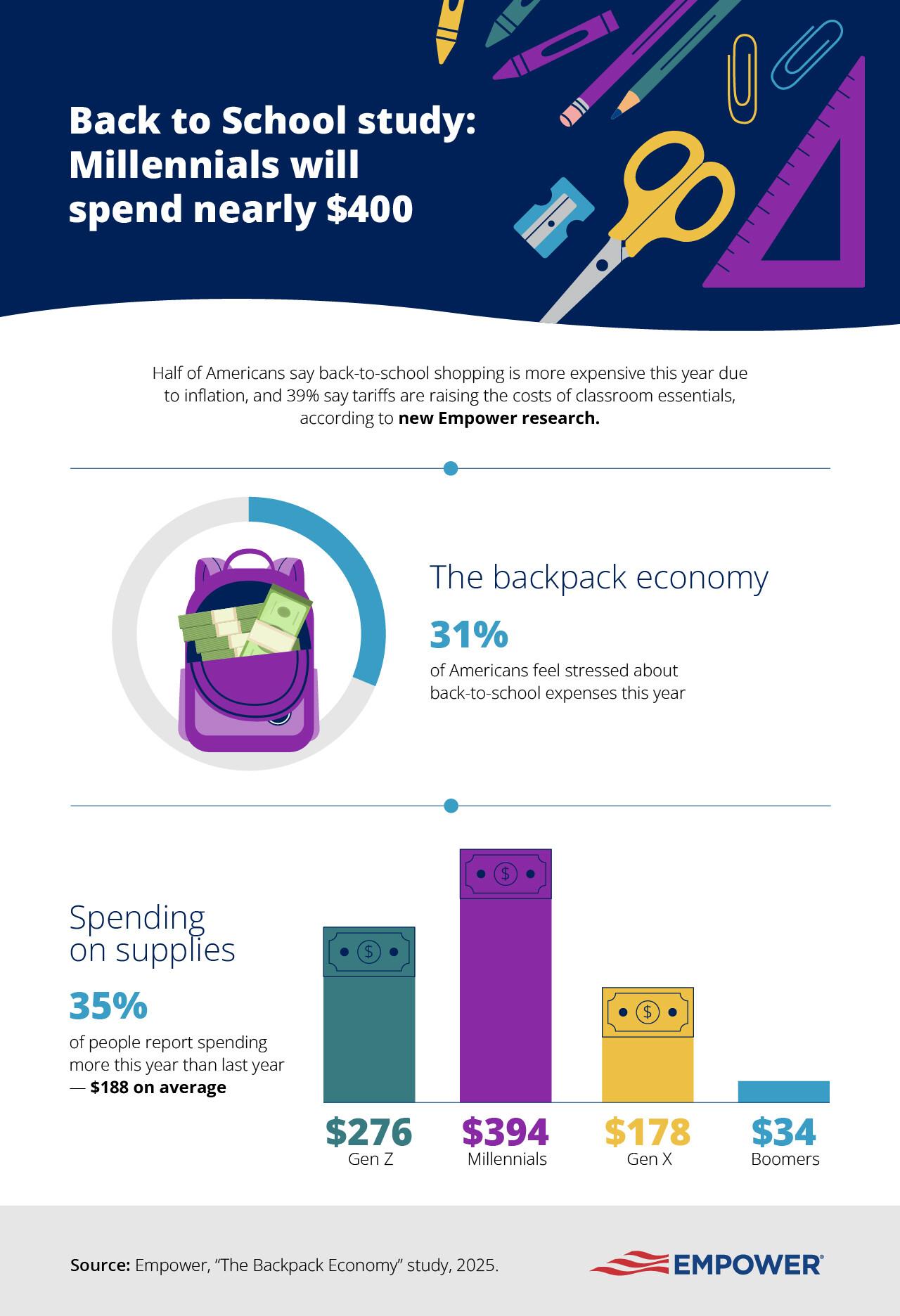
Nearly 1 in 3 Americans (31%) report feeling stressed about back-to-school expenses this year, according to new research from Empower. That number climbs sharply among Millennials and Gen Z, where nearly half (43%) say the season comes with financial anxiety.
Half of Americans say back-to-school shopping is more expensive than it was last year due to inflation and rising prices (50%). Nearly 4 in 10 (39%) cite tariffs as a factor making supplies more expensive.
Swiping smart: how families are paying for back-to-school
More than a third of respondents report they’re spending more this year than last year (35%). Americans say they are spending $188 on back-to-school supplies this season, with younger generations spending the bulk:
- Millennials: $394
- Gen Z: $276
- Gen X: $178
- Boomers: $34
To fund these costs, families are turning to a mix of payment strategies:
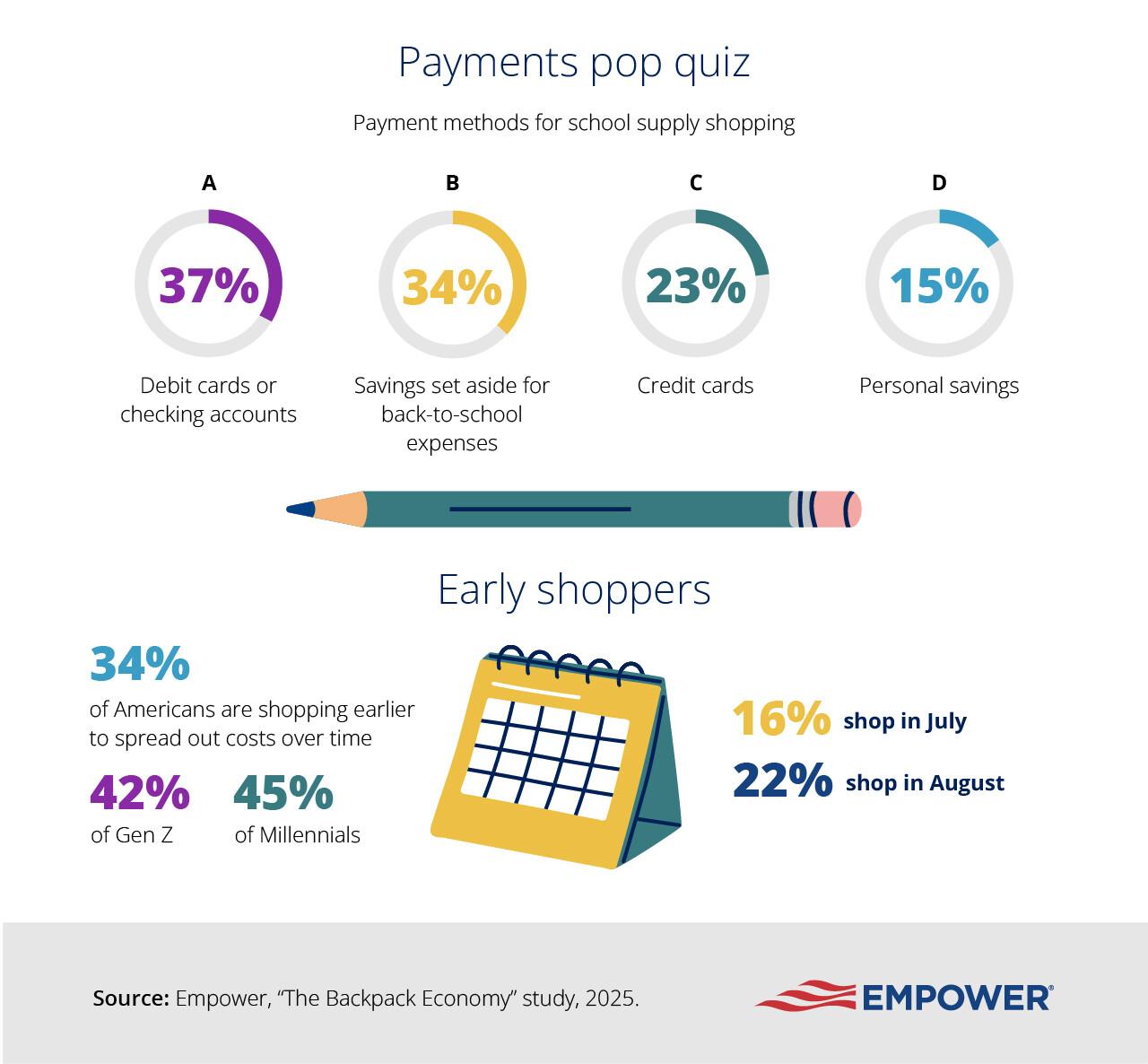
- 37% use debit cards or checking accounts
- 23% rely on credit cards
- 15% dip into personal savings
- 7% turn to friends or family
- 5% opt for buy now, pay later (BNPL) options
One in 5 Millennials say they use BNPL to pay for back-to-school costs (19%).
Early shoppers
Many are getting a head start: 34% of Americans shop for back-to-school items earlier than they used in order to spread out costs over time (42% Gen Z, 45% Millennials). Nearly 1 in 5 shop in July (16%), with 22% continuing into August.
A third of Americans (34%) have set aside specific savings for back-to-school expenses, a habit more common among younger generations (46% Gen Z; 48% Millennials).
Cutting back to gear up
To make room in their budgets, Americans—especially younger ones—are trimming elsewhere:
- 42% of Millennials are cutting back in other areas to afford school expenses
- 51% of Americans say even small purchases now feel like big decisions
What’s in the bag?
Back-to-school spending isn’t just about notebooks and pencils anymore. Here’s where the dollars are going:
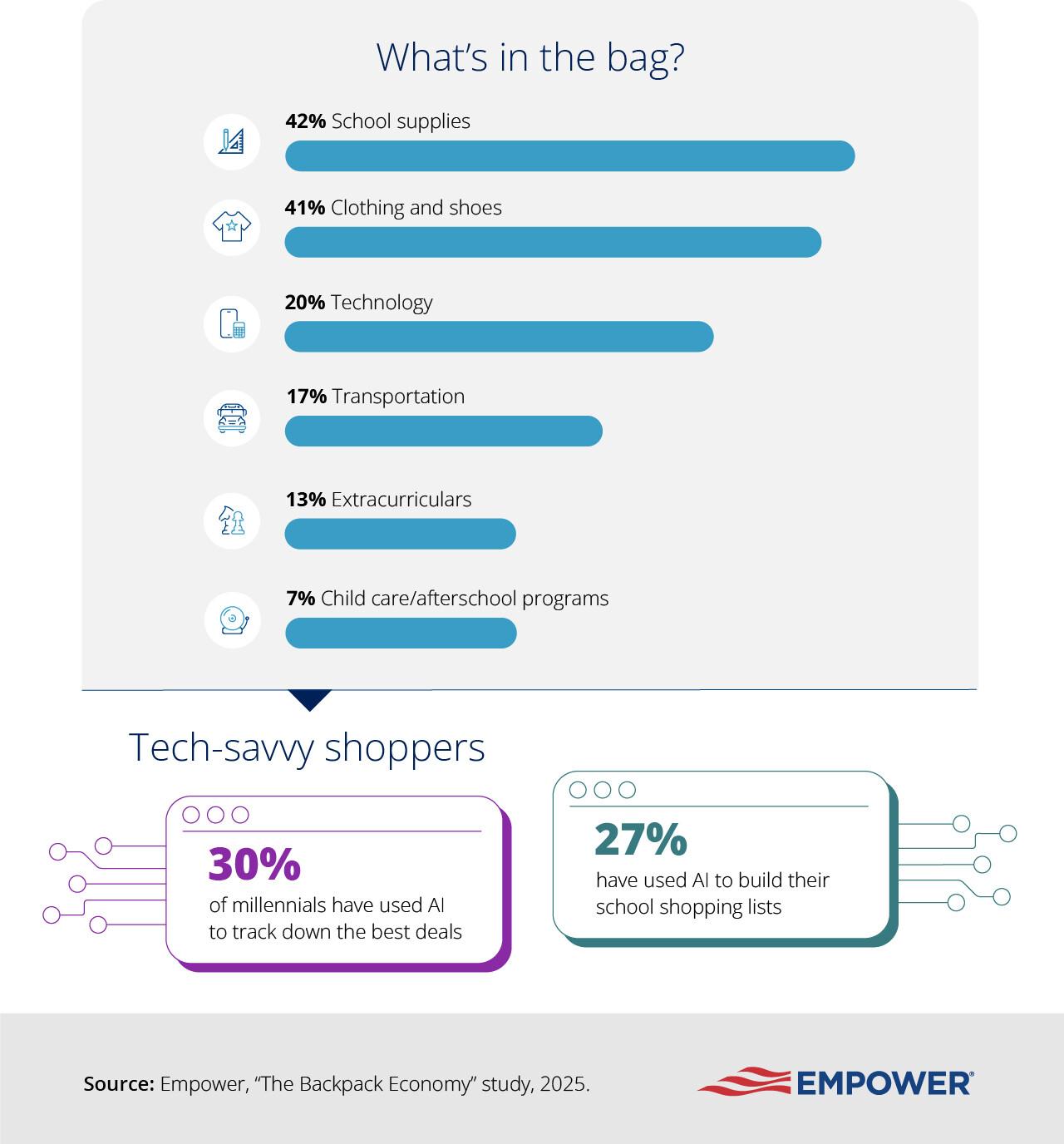
- School supplies (notebooks, backpacks, etc.): 42%
- Clothing and shoes: 41%
- Technology: 20%
- Transportation (bus passes, gas): 17%
- Extracurriculars (sports, clubs): 13%
Childcare/afterschool programs: 7%
Deals, discounts, and digital help
In a world where every dollar counts, 74% of shoppers say price and discounts top their decision-making list, followed by quality (56%), brand (30%), and loyalty rewards (26%). More than 4 in 10 (43%) Americans say they wait for a sale or discount before purchasing—especially Gen Z (54%) and Millennials (52%).
Tech-savvy shoppers are even turning to artificial intelligence:
- 30% of Millennials have used AI to track down the best deals
- 27% have used AI to build their school shopping lists
Methodology:
Empower’s “Backpack Economy” study is based on online survey responses from 2,201 Americans ages 18+ from June 29 - 31, 2025. The survey is weighted to be nationally representative of U.S. adults.
How well are your investments performing?
Analyze your portfolio in minutes and receive a target allocation for your goals.
RO4717542-0825
 Get The Currency newsletter
News and know-how for whatever money decision comes next.
*If you’re already registered with Empower, please use the same email address as your existing account.
The content contained in this blog post is intended for general informational purposes only and is not meant to constitute legal, tax, accounting or investment advice. You should consult a qualified legal or tax professional regarding your specific situation. No part of this blog, nor the links contained therein is a solicitation or offer to sell securities. Compensation for freelance contributions not to exceed $1,250. Third-party data is obtained from sources believed to be reliable; however, Empower cannot guarantee the accuracy, timeliness, completeness or fitness of this data for any particular purpose. Third-party links are provided solely as a convenience and do not imply an affiliation, endorsement or approval by Empower of the contents on such third-party websites. This article is based on current events, research, and developments at the time of publication, which may change over time.
Certain sections of this blog may contain forward-looking statements that are based on our reasonable expectations, estimates, projections and assumptions. Past performance is not a guarantee of future return, nor is it indicative of future performance. Investing involves risk. The value of your investment will fluctuate and you may lose money.
Certified Financial Planner Board of Standards Inc. (CFP Board) owns the certification marks CFP®, CERTIFIED FINANCIAL PLANNER™, CFP® (with plaque design), and CFP® (with flame design) in the U.S., which it authorizes use of by individuals who successfully complete CFP Board's initial and ongoing certification requirements.