

COLA increase 2027: Social Security payments to rise 3.6%
COLA increase 2027: Social Security payments to rise 3.6%
On average, the 2027 Cost-of-Living Adjustment (COLA) increase will put an additional $75 in the pockets of Social Security recipients each month
COLA increase 2027: Social Security payments to rise 3.6%
On average, the 2027 Cost-of-Living Adjustment (COLA) increase will put an additional $75 in the pockets of Social Security recipients each month

10.19.2026
Key takeaways
- The IRS announced Social Security benefits and Supplemental Security Income (SSI) payments will increase 3.6% in 2027.
- Over the last decade the COLA increase has averaged about 3.4%. In 2026, the increase was 2.8%.
- The standard Medicare Part B premium is projected to rise by 3.3%, which may reduce the net monthly increase many retirees see in their Social Security checks.
How much will COLA increase in 2027?
The average monthly check for the nation’s 71 million Social Security beneficiaries will increase 3.6% starting in January 2027. That’s an increase of $75 a month, on average. The 7.3 million Americans who receive Supplemental Security Income (SSI), a program for low-income and disabled people, will see their first COLA increase on December 31, 2026.1
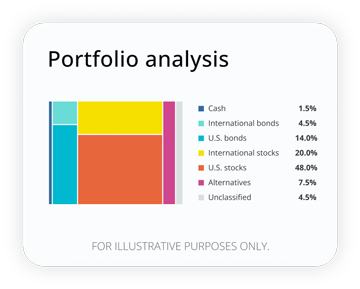
How well are your investments performing?
Analyze your portfolio in minutes and receive a target allocation for your goals.
But for some retirees, the increase may still fall short of rising expenses. In a September AARP survey, 76% of adults ages 50 and older said a projected 3.5% cost-of-living adjustment (COLA) for 2027 would not be enough to keep up with rising prices. Additionally, 71% said an increase of 5% to 8% would be sufficient to help Social Security recipients afford everyday expenses.²
Cost of living increase 2026 vs 2027: What’s changed for retirees
The table below compares the 2026 and 2027 Social Security cost-of-living adjustments (COLA). According to the Social Security Administration (SSA), the 2.8% COLA for 2026 increased the estimated average monthly retirement benefit from $2,015 to $2,071.3 For 2027, the 3.6% COLA is expected to increase the average monthly retirement benefit from $2,095 to $2,170.4
Year | COLA % Increase | Average monthly benefit (retired worker) |
2026 | 2.8 % | $2,071 |
2027 | 3.6 % | $2,170 |
Who is eligible for Social Security COLA?
The COLA applies to people who get Social Security, including retirees, people with disabilities, survivors of deceased workers, and spouses or dependents who receive benefits based on someone else’s record. It also applies to SSI recipients.5
Social security maximum taxable earnings 2027
In 2027, the maximum amount of earnings subject to Social Security tax is $192,300.6 The IRS raises the maximum amount of earnings subject to Social Security taxes each year to keep pace with increases in average wages.
Read more: Is Social Security taxable?
Why is Social Security going up?
When costs heat up, COLAs usually do as well. In recent years, COLAs have varied significantly: A record 8.7% increase in 2023, followed by more modest adjustments of 3.2% in 2024, 2.5% in 2025, and 2.8% in 2026. The largest jump in history occurred back in 1980 when the COLA skyrocketed to 14.3%.7
Every year since 1975, Social Security benefits have been reviewed and recalculated to help keep pace with inflation. It’s a way to protect the purchasing power of payments so they don’t lose their strength when things become more expensive. But if there’s no inflation, like in 2009, 2010, and 2015, there’s no COLA.8
The Social Security Administration (SSA) analyzes data from the Consumer Price Index for Urban Wage Earners and Clerical Workers (CPI-W) to set the annual COLA. In general, the CPI-W measures the average cost changes for a variety of common products and services, like food, clothing, and transportation. If there is at least a 0.1% increase when comparing third-quarter numbers with the same period from the previous year (July, August, and September), Social Security benefits will typically see an increase.9
Will I get more from Social Security in 2027?
It depends. Seventy percent of people elect to have their monthly premiums for Medicare Part B — medical insurance that helps pay for doctor visits and medical equipment — automatically deducted from their Social Security checks.10 If you fall into this group, there is a chance a Medicare rate hike could offset any extra you receive from a cost-of-living adjustment.
The standard monthly premium for Medicare Part B is projected to increase to $209.50 in 2027, up from $202.90 in 2026. That $6.60 difference amounts to a 3.3% increase year-over-year.11 High-income earners may pay additional monthly costs, known as income-related monthly adjustment amounts, or IRMAAs.12
Will a bigger benefit be enough to fund my retirement?
Around 1 in 5 U.S. residents receive Social Security benefits, though Social Security was never designed to be a person’s sole or most prominent source of retirement income.13,14 Many financial professionals suggest that an amount of around 80% of your annual income can cover your cost of living in retirement, and Social Security could help with a portion of that because it’s based on your total lifetime earnings. It’s a good idea to consider contributing to a 401(k) plan, an IRA, or another tax-advantaged type of investment account to help grow your nest egg.
What if I don’t plan on collecting Social Security in 2027?
You can begin collecting Social Security retirement benefits as early as age 62. But if you're not ready to claim benefits in 2027, you can still benefit from the year's cost-of-living adjustment (COLA). That's because annual COLAs are automatically factored into your future Social Security payments, even if you haven't started collecting benefits.15 Waiting to claim can also increase your monthly benefit, up to age 70.16
Read more: More Americans are taking Social Security early — is it the right move?
How can I check my Social Security status?
You can check your Social Security status online by creating a My Social Security account online at the Social Security Administration website. With an account, you’ll be able to view your profile page, monitor the status of an application, view your earnings history, and see estimated benefits.
1 Social Security Administration, “Social Security Announces 3.6 Percent Benefit Increase for 2027,” October 2026.
2 AARP, “Most Older Adults Say a Projected 3.5% Social Security COLA Would Fall Short,” October 2026.
3 Social Security Administration, “2026 Social Security Changes,” October 2025.
4 Social Security Administration, “2027 Social Security Changes,” October 2026.
5 Social Security Administration, “Social Security Announces 3.6 Percent Benefit Increase for 2027,” October 2026.
6 Ibid.
7 Social Security Administration, “Cost of Living Adjustments,” October 2026.
8 Ibid
9 Social Security Administration, “Cost of Living Adjustment,” October 2026.
10 AARP, “How the COLA Affects Social Security Benefits,” October 2026.
11 Boards of Trustees of the Federal Hospital Insurance and Federal Supplementary Medical Insurance Trust Funds, “2026 Medicare Trustees Report,” June 2026.
12 Centers for Medicare & Medicaid Services, “2026 Medicare Parts A & B Premiums and Deductibles,” November 2025.
13 Center on Budget and Policy Priorities, “Policy Basics: Top Ten Facts about Social Security,” May 2024.
14 Social Security Administration, “Understanding the Benefits,” 2024.
15 Social Security Administration, “Social Security Benefit Amounts,” October 2026.
16 Social Security Administration, “Delayed Retirement Credits,” October 2026.
RO6023685-1026
 Get The Currency newsletter




The Currency editors
Staff contributors
The CurrencyTM writers and editors cover the latest financial news and insights shaping how we live, work, and play. The team provides accurate, data-driven, and timely content aimed at empowering financial freedom for all.
The content contained in this blog post is intended for general informational purposes only and is not meant to constitute legal, tax, accounting or investment advice. You should consult a qualified legal or tax professional regarding your specific situation. No part of this blog, nor the links contained therein is a solicitation or offer to sell securities. Compensation for freelance contributions not to exceed $1,250. Third-party data is obtained from sources believed to be reliable; however, Empower cannot guarantee the accuracy, timeliness, completeness or fitness of this data for any particular purpose. Third-party links are provided solely as a convenience and do not imply an affiliation, endorsement or approval by Empower of the contents on such third-party websites.
Certain sections of this blog may contain forward-looking statements that are based on our reasonable expectations, estimates, projections and assumptions. Past performance is not a guarantee of future return, nor is it indicative of future performance. Investing involves risk. The value of your investment will fluctuate and you may lose money.
Certified Financial Planner Board of Standards Inc. (CFP Board) owns the certification marks CFP®, CERTIFIED FINANCIAL PLANNER™, CFP® (with plaque design), and CFP® (with flame design) in the U.S., which it authorizes use of by individuals who successfully complete CFP Board's initial and ongoing certification requirements.
Advisory services are provided for a fee by Empower Advisory Group, LLC (“EAG”). EAG is a registered investment adviser with the Securities and Exchange Commission (“SEC”) and subsidiary of Empower Annuity Insurance Company of America. Registration does not imply a certain level of skill or training.