

Secret to Success
Secret to Success
New Empower research explores the pursuit of financial success: Money, happiness, and the “Factor of Four”
Insights into Americans’ definitions of financial success, the actions to reach it, and the barriers people face along the way.
New Empower research explores the pursuit of financial success: Money, happiness, and the “Factor of Four”
Insights into Americans’ definitions of financial success, the actions to reach it, and the barriers people face along the way.
Is there a secret to financial success? Most Americans (52%) say “yes” – and the average salary considered successful is $270,000 per year, and $5.3 million in overall net worth.
People say success is about the “Factor of Four”: hard work (84%); talent (65%); who you know (55%) and luck and circumstance (51%). For 1 in 5 younger generations (Gen Zers and Millennials 19%) a secret to success is ‘fake it ‘til you make it.’
“Fortune favors the bold, and people feel success is within their grasp with the right combination of dreaming and planning. It’s about disciplined, smart money choices, but overall people define financial success as very meritocratic, and a little serendipitous. There’s a sense that effort and outperformance will take you far.”
Rebecca Rickert, Head of Communications at Empower
Still, nearly half of Americans (47%) feel they’ll never achieve the level of success they’re seeking. Just 37% of people consider themselves financially successful right now – with higher numbers of men than women (42% compared to 33%). Only half (50%) of people state they are or will be better off financially than their parents, a long-held meterstick for generational success.
Barriers to success
More than one third say the economy (35%) and income instability – irregular or insufficient income streams (30%) is a culprit, along with lack of knowledge about managing finances (20%). Nearly a third say the biggest obstacle to success is not setting clear financial goals (28%). Over 1 in 4 (26%) say procrastination or delaying financial planning or decision-making gets in the way. People see a lack of savings (35%), overspending and not budgeting effectively (37%) and debt (36%) as barriers to success.

Success, realized
For most people, financial success is found in tangible wins: being able to pay bills on time (63%), owning a home (52%), affording experiences like travel and entertainment (47%). For 40%, it’s about retiring at a goal age – and while they are working, enjoying the job (42%).
Having a financial plan (45%), building up retirement plan savings like 401(k) investments (30%), and investing in stocks (27%) are top money moves people say propel greater success. One in 3 people (30%) say getting good financial advice is worth its weight in gold.

Americans say their personal definition of success is often at odds with what society prizes. Less than half of people (43%) define financial success as having a certain amount of money or assets. Conversely, people say society equates success with wealth (59%), power (44%), and fame (35%). Just 6% say they value “power” as a measure of success for themselves.
Almost half of Americans (49%) feel less financially successful compared to others. 60% say that for their generation, financial success is much harder to achieve than for other generations – a sentiment highest among Millennials at 69%, and lowest among Boomers at 49%. Still, the definition of success may be evolving, as 83% agree that each generation has its own idea of success.

Most Americans agree (71%) that there is no single measurement for financial success. One point of agreement: 61% say you can never have enough money.

*ABOUT THE STUDY
The Empower “Secret to Success” study is based on online survey responses from 2,203 Americans ages 18+ from September 13-14, 2024. The survey is weighted to be nationally representative of U.S. adults.
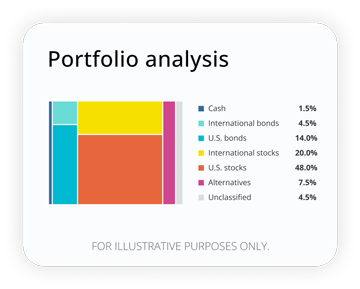
How well are your investments performing?
Analyze your portfolio in minutes and receive a target allocation for your goals.
RO4334773-0325
 Get The Currency newsletter
News and know-how for whatever money decision comes next.
*If you’re already registered with Empower, please use the same email address as your existing account.
The content contained in this blog post is intended for general informational purposes only and is not meant to constitute legal, tax, accounting or investment advice. You should consult a qualified legal or tax professional regarding your specific situation. No part of this blog, nor the links contained therein is a solicitation or offer to sell securities. Compensation for freelance contributions not to exceed $1,250. Third-party data is obtained from sources believed to be reliable; however, Empower cannot guarantee the accuracy, timeliness, completeness or fitness of this data for any particular purpose. Third-party links are provided solely as a convenience and do not imply an affiliation, endorsement or approval by Empower of the contents on such third-party websites. This article is based on current events, research, and developments at the time of publication, which may change over time.
Certain sections of this blog may contain forward-looking statements that are based on our reasonable expectations, estimates, projections and assumptions. Past performance is not a guarantee of future return, nor is it indicative of future performance. Investing involves risk. The value of your investment will fluctuate and you may lose money.
Certified Financial Planner Board of Standards Inc. (CFP Board) owns the certification marks CFP®, CERTIFIED FINANCIAL PLANNER™, CFP® (with plaque design), and CFP® (with flame design) in the U.S., which it authorizes use of by individuals who successfully complete CFP Board's initial and ongoing certification requirements.