

Fed interest rates stay steady: What this means for personal finances
Fed interest rates stay steady: What this means for personal finances
The Federal Reserve’s decision to hold rate steady keeps borrowing costs elevated — but it also keeps the door open for higher yields on savings accounts
Fed interest rates stay steady: What this means for personal finances
The Federal Reserve’s decision to hold rate steady keeps borrowing costs elevated — but it also keeps the door open for higher yields on savings accounts

08.01.2025

Listen
·Fed interest rates stay steady: What this means for personal finances
Key takeaways
- The Fed decided to hold interest rates steady during its July meeting as inflation eased to 2.7%.
- Strong job growth could signal further economic resilience, making near-term rate cuts less essential.
- High-yield savings and CDs could continue to offer high-interest returns for now.
The Federal held rates steady in July, and new data indicates future cuts could be delayed as inflation cools and job growth holds.
After months of speculation, the Federal Reserve decided to keep interest rates unchanged in July. This marks the seventh consecutive meeting without a rate change, even though some in the industry expected a rate cut by now.1 Rather, due in part to recent labor and inflation data, the Fed opted to stay the course through the summer.
This rate decision has several impacts on the average U.S. household. First, interest rates influence everything from mortgages and credit card rates to savings and account interest yields. The Fed’s decision comes at a time when some Americans are balancing cautious optimism with long-term financial planning.
Fed interest rate changes remain on pause
As markets expected, the Fed opted to keep interest rates steady for now during its July session — and may do so again in August.2 The Fed’s preferred inflation data metric was up 2.7% as of June, slightly above its 2% goal.3 And with employment holding at 4.2%, there was one fewer source of urgency to make the kind of interest rate changes that can create wide-reaching economic impacts.4
Labor figures tell a supporting story. June’s job report showed 147,000 new positions, beating expectations. Unemployment dipped to 4.1%. Long-term joblessness ticked up, however.5
These conditions may give the Fed a bit of breathing room. The Fed decision may suggest that they do not see specific signs of runaway inflation or economic overheating, prompting them to hold off on changes for now. This meeting featured some unusual internal dissent, however: Two Fed Governors (Michelle Bowman and Christopher Waller) voted to cut rates by 25 basis points, marking the first time since 1993 that multiple governors dissented.6
What the Fed interest rate decision means for the economy
Markets, as well as voices in Washington, D.C., had hoped for a July rate cut.7 But the combination of moderate inflation, robust employment, and persistent price stickiness on consumer goods and homes cooled expectations.
Shelter costs (home building, buying and selling, and rentals) fell by 0.3.% in May.8 With core inflation remaining above the Fed’s comfort level, it’s possible that they may be taking a wait-and-see approach. New trade policies and tariffs may also pressure supply chains later this year, which could give the Fed reason to pause before changing rates.9
Consumer resilience has stayed strong despite higher-than-hoped for inflation levels. People are spending, particularly on services, even as they get strategic with their spending in categories like apparel and home goods.
How the Fed’s interest rate hold impacts everyday finances
Elevated interest rates affect borrowers and savers differently. Borrowing in a high-interest environment is more expensive: Average credit card APRs remain above 20%, and new mortgage rates still hover near 7%.10 For home buyers, this could lead to slower decision-making or holding off on a move until rates decline. And for current homeowners, refinancing a mortgage may have to come later, if interest rates decline.
Savers may benefit from interest rates holding steady. Some banks’ top-yield savings accounts offer between 4.11% and 4.30% interest.11 Rates on Certificate of Deposit (CD) accounts are similarly elevated — some going as high as 4.5% APY on six-month CDs.12 If these rates hold steady through the summer, savers may see higher yields as well.
Pausing the Fed borrowing appears to have a stabilizing force for the markets. The first quarter of 2025 witnessed volatility, driven in part by tariff talks and declines in the equities market. Investors have regained some confidence, however, as inflation has slowed and rate cuts still remain on the horizon — even if they’re not in the plans right now.
What the Fed is watching for
The Fed may be looking to make data-driven decisions before opting to change interest rates. The next few Consumer Price Index (CPI) and jobs reports, along with wage growth and consumer spending, may shape the timeline for future adjustments.
- Prices rose 2.7% in May, according to the Personal Consumption Expenditures (PCE) report, which the Fed monitors closely.
- Wholesale prices (what businesses pay before retail prices) did not move much in June, but are still growing faster than the Fed may want before pursuing a rate cut.
- Consumer spending decreased slightly in May, but rebounded in June by 0.6%. Retail sales, adjusted for seasonal fluctuations, was up 3.9% year-over-year.
These figures don’t outline a specific economic trajectory. Inflation may be falling, and the economy could be cooling down, but consumers are still interested in paying for goods and services (if with more restraint). If these trends hold through the next few report cycles, it may be possible that rate cuts could come later this year.
How households are adjusting
Americans are approaching finances with focus. Their emergency savings rates are rising, and the average 401(k) balance grew 1.1% in Q1 despite market volatility. Spending hasn’t stopped, but it’s become more targeted. People are still traveling, going to restaurants, and investing in experiences. They’re just doing it with more intention, and with a keen eye on value.
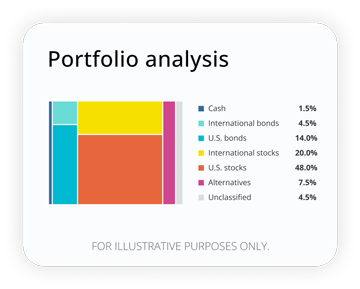
How well are your investments performing?
Analyze your portfolio in minutes and receive a target allocation for your goals.
1 Bureau of Labor Statistics, “Consumer Price Index Summary,” July 2025
2 CNBC, “Federal Reserve is likely to hold interest rates steady this week. Here’s what that means for your money,” June 2025
3 Reuters, “VIEW US reports benign PCE inflation in May,” June 2025
4 Yahoo Finance, “US labor market adds 139,000 jobs in May, unemployment holds steady at 4.2%,” June 2024
5 Bureau of Labor Statistics, “The employment situation, June 2025,” July 2025
6 Wall Street Journal, “Fed Governors Could Break Ranks as Trump Intensifies Powell Pressure,” July 2025
7 New York Times, “White House Keeps Pressure on Powell Over Rate Cuts and Renovations,” July 2025
8 Marketplace, “Construction spending fell more than expected in May,” July 2025
9 U.S. Trade Representative, “The President’s 2025 Trade Policy Agenda,” Accessed July 2025
10 FreddieMac, “Mortgage Rates Continue to Move Up,” July 2025
11 CBS News, “What are today's savings interest rates?” July 2025
12 CNBC, “12 best CD rates of August 2025: Up to 4.40% APY,” July 2025
13 Nasdaq, “First Quarter 2025 Review & Outlook,” Accessed July 2025
RO 4709529-0825
 Get The Currency newsletter



The Currency editors
Staff contributors
The CurrencyTM writers and editors cover the latest financial news and insights shaping how we live, work, and play. The team provides accurate, data-driven, and timely content aimed at empowering financial freedom for all.
The content contained in this blog post is intended for general informational purposes only and is not meant to constitute legal, tax, accounting or investment advice. You should consult a qualified legal or tax professional regarding your specific situation. No part of this blog, nor the links contained therein is a solicitation or offer to sell securities. Compensation for freelance contributions not to exceed $1,250. Third-party data is obtained from sources believed to be reliable; however, Empower cannot guarantee the accuracy, timeliness, completeness or fitness of this data for any particular purpose. Third-party links are provided solely as a convenience and do not imply an affiliation, endorsement or approval by Empower of the contents on such third-party websites. This article is based on current events, research, and developments at the time of publication, which may change over time.
Certain sections of this blog may contain forward-looking statements that are based on our reasonable expectations, estimates, projections and assumptions. Past performance is not a guarantee of future return, nor is it indicative of future performance. Investing involves risk. The value of your investment will fluctuate and you may lose money.
Certified Financial Planner Board of Standards Inc. (CFP Board) owns the certification marks CFP®, CERTIFIED FINANCIAL PLANNER™, CFP® (with plaque design), and CFP® (with flame design) in the U.S., which it authorizes use of by individuals who successfully complete CFP Board's initial and ongoing certification requirements.