

Earnings update: AI spending stays strong but will business demand keep pace?
Earnings update: AI spending stays strong but will business demand keep pace?
Nvidia’s record profit and upbeat forecast highlight how AI continues to drive tech earnings and those in the data center boom
Earnings update: AI spending stays strong but will business demand keep pace?
Nvidia’s record profit and upbeat forecast highlight how AI continues to drive tech earnings and those in the data center boom

11.26.2025

Listen
·Earnings update: AI spending stays strong but will business demand keep pace?
Key takeaways
- Nvidia’s quarterly profit hit $31.9 billion, up 65% year over year
- Global data center spending is projected to reach $939 billion by 2028
- Consumer brands expand AI-powered services for shoppers
- Most companies remain in pilot phase for AI uses
Nvidia’s latest earnings report delivered record profits and another strong forecast, reinforcing its role at the center of AI chip demand. Data center construction and infrastructure spending continue to ripple across industries in anticipation of demand.
Third-quarter earnings reporting wrapped up for most U.S. companies in November with intense scrutiny on whether massive AI investments by big tech companies will be met with real-world adoption.1
Nvidia Corp. headlined the last full week of earnings by delivering a strong-than-expected revenue forecast, signaling that demand for AI chips remains strong as some question the pace of AI data center builds and other infrastructure spending.2
Nvidia reported a quarterly profit of $31.9 billion — up 65% from a year earlier and 245% over two years — and issued another very upbeat forecast. Nvidia CEO Jensen Huang said his company is seeing something different than any sort of AI bubble.3
In October, the chipmaker became the first to reach a $5 trillion market capitalization before retreating from that benchmark.4
Nvidia’s results are often seen as a barometer for the broader tech sector, given its roughly 90% share of the AI chip market.5 But beyond chip sales, data center buildouts — driven by expectations of soaring computing demand — are becoming a key focus for tech watchers.6
Read more: GenAI tools that are reshaping daily life and business
Heavy duty spending on AI data centers
The global data center market is projected to reach $939 billion by 2028, up from $406 billion last year. Most of the spending is coming from Amazon, Microsoft, Meta, Google, and Apple, which together invested about $350 billion in data centers this year.7
That surge in data center construction and infrastructure investment is increasingly showing up in the earnings of companies outside of Silicon Valley.8
100-year-old heavy-equipment maker Caterpillar reported record third-quarter sales of $17.6 billion, driven largely by data-center demand for its power generators and related equipment. The company is expanding production in Indiana to meet a $2.4 billion jump in backlogged orders last quarter.9
Cummins and Rolls Royce are just two of several established industrial conglomerates cashing in on the rising demand for generators, back-up power systems and other data center electricity needs.10 It’s the same for oilfield services companies like SLB, Halliburton and Baker Hughes — all diversifying into AI power needs and other infrastructure.11
AI data centers were a bright spot for air-conditioning pioneer Carrier, lifting third-quarter sales to $5.6 billion. Its commercial HVAC revenue from data-center clients is expected to double to $1 billion this year, offsetting weaker residential HVAC sales impacted by the housing market.12
AI servers consume massive amounts of power and generate heat that requires advanced cooling systems. Companies specializing in needs like liquid and air cooling, energy management, and efficiency — including Eaton, Vertiv Holdings, and Schneider Electric — have reported strong sales. All three firms have made acquisitions to expand capacity, including Eaton’s $9.5 billion purchase of Boyd Thermal earlier this month.13
Where AI meets the consumer
But who’s using all that data? Recent earnings reports show AI spreading to more consumer-facing companies hoping to improve order efficiency and customer service, among other things.
E-commerce platform Shopify said orders from AI-driven searches rose 11-fold since January.14 Third-quarter revenue climbed 32% to $2.84 billion from the previous quarter, and in September Shopify announced a deal with OpenAI that lets merchants sell directly through ChatGPT.15
eBay posted $2.8 billion in revenue for the third quarter, up 9% year-over-year. The online marketplace said it’s been deploying AI for shipping estimates, automated listings, photo enhancements, and a new shopping assistant that helps buyers search with natural language.16
Direct wellness and beauty products seller Nu Skin has an in-house large language model that provides customers with personalized advice while gathering insights to tailor product offerings.17 Other retailers such as Walmart, Ralph Lauren, and Williams-Sonoma are betting that agentic AI will reshape how consumers find and purchase products, among other uses.18
Colgate-Palmolive, facing more selective consumers amid economic uncertainty and rising costs, is making agentic AI a core part of its 2030 growth plan to improve demand forecasting, commerce strategy, and profitability. On an earnings call, CEO Noel Wallace described AI agents as its next frontier.19
AI is also a big theme in insurance. Allstate CEO Tom Wilson said AI digital agents will help speed up claims processing and deliver more personalized services.20 MetLife said its in-house AI platform, MetIQ, helped lower expenses in the third quarter, part of a $3 billion spend to overhaul technology at the insurer.21
Read more: How AI is getting personal with shoppers
Keeping pace with AI
Empower research shows that most executives (96%) feel an urgency to incorporate AI into their business operations, though execution is often slower and full-scale adoption is limited.
A key question moving forward is whether business demand will keep pace with AI capacity. AI data center construction — excluding the technology inside — is expected to surpass investment in traditional office buildings this year.22
The companies doing much of the spending are in the so-called Magnificent Seven — Apple, Amazon, Alphabet, Meta, Microsoft, Nvidia, and Tesla. Those stocks made up 37% of the S&P 500 last month, nearly triple their share a decade ago.23
Soaring AI stock valuations have created a “wealth effect” among higher-income households, who’ve been spending strong as other consumers cut back. Gains from AI stocks accounted for about $180 billion in consumer spending over the past year, according to one estimate.24
Some economists see the current economy as two-track — one powered by artificial intelligence, the other moving much slower.25
While AI tools like ChatGPT have captured the public’s attention and enthusiasm, business use is different and can be more measured. A new McKinsey survey found that AI use is broadening among companies, but primarily for pilot projects. About one-third companies have scaled AI enterprise-wide, and fewer than 40% have seen an impact on profits.26
Some economists see the AI boom and its infrastructure build out as continuing — if the technology delivers on work productivity promises and if companies fully buy in.27
Read more: The new workflow: How collaboration software is transforming the modern workplace
This material is neither an endorsement of any security, index or sector nor a solicitation to offer investment advice or sell products or services. Past performance is no guarantee of future results
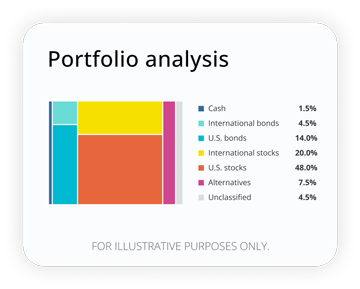
How well are your investments performing?
Analyze your portfolio in minutes and receive a target allocation for your goals.
1 CNBC, “Nvidia sent a strong signal on AI infrastructure — but is it a bubble barometer,” November 2025.
2 CNN, “Nvidia beats earnings expectations, even as bubble concerns mount,” November 2025.
3 Bloomberg, “Nvidia’s Post-Earnings Rally Fades After Bubble Fears Return,” November 2025.
4 New York Times, “Nvidia’s Profit Jumps 65% to $31.9 Billion. Is It Enough for Wall St.?,” November 2025.
5 New York Times, “Nvidia’s Profit Jumps 65% to $31.9 Billion. Is It Enough for Wall St.?,” November 2025.
6 CNBC, “Nvidia sent a strong signal on AI infrastructure — but is it a bubble barometer,” November 2025.
7 Business Insider, “Meet the non-tech companies cashing in on the AI data center spending boom,” September 2025.
8 The A.I. Spending Frenzy Is Propping Up the Real Economy, Too,” August 2025.
9 The Wall Street Journal, “Caterpillar’s Shares Soar on AI Data Centers’ Drive for More Power,” October 2025.
10 Business Insider, “Meet the non-tech companies cashing in on the AI data center spending boom,” September 2025.
11 Reuters, “Oilfield giants pivot to booming AI infrastructure as drilling demand wanes,” October 2025.
12 Facilities Dive, “Strong commercial HVAC sales help Carrier offset residential weakness,” October 2025.
13 Barron’s “AI Data Centers Need Electricity. They Need This, Too.,” November 2025
14 Yahoo Finance! “Shopify Inc Q3 2025 Earnings Call Highlights: Impressive Growth and Strategic AI Integration,” November 2025.
15 Barron’s Shopify Stock Falls After Earnings. Why Good Wasn’t Good Enough,” November 2025.
16 CNN, “How 30-year-old eBay is making a comeback thanks to AI,” November 2025.
17 Bloomberg, “The Case for AI Is (Finally) Showing Up in Earnings,” November 2025.
18 CIO Dive, “Colgate-Palmolive plans agentic AI push in pursuit of growth,” November 2025.
19 CIO Dive, “Colgate-Palmolive plans agentic AI push in pursuit of growth,” November 2025.
20 Bloomberg, “The Case for AI Is (Finally) Showing Up in Earnings,” November 2025.
21S&P Global, “US life insurance Q3'25 recap: execs talk private credit, AI investments,” November 2025.
22 The New York Times, “The A.I. Spending Frenzy Is Propping Up the Real Economy, Too,” August 2025
23 MarketWatch, “The ‘Magnificent Seven’ have never been this important to the stock market — and a big test lies ahead,” October 2025.
24 The Wall Street Journal, “How the U.S. Economy Became Hooked on AI Spending,” November 2025
25 The New York Times, “The A.I. Boom Is Driving the Economy. What Happens if It Falters?” November 2025.
26 McKinsey, “The state of AI in 2025: Agents, innovation, and transformation,” November 2025.
27 The New York Times, “The A.I. Boom Is Driving the Economy. What Happens if It Falters?” November 2025.
RO5018013-1125
 Get The Currency newsletter



The Currency editors
Staff contributors
The CurrencyTM writers and editors cover the latest financial news and insights shaping how we live, work, and play. The team provides accurate, data-driven, and timely content aimed at empowering financial freedom for all.
The content contained in this blog post is intended for general informational purposes only and is not meant to constitute legal, tax, accounting or investment advice. You should consult a qualified legal or tax professional regarding your specific situation. No part of this blog, nor the links contained therein is a solicitation or offer to sell securities. Compensation for freelance contributions not to exceed $1,250. Third-party data is obtained from sources believed to be reliable; however, Empower cannot guarantee the accuracy, timeliness, completeness or fitness of this data for any particular purpose. Third-party links are provided solely as a convenience and do not imply an affiliation, endorsement or approval by Empower of the contents on such third-party websites. This article is based on current events, research, and developments at the time of publication, which may change over time.
Certain sections of this blog may contain forward-looking statements that are based on our reasonable expectations, estimates, projections and assumptions. Past performance is not a guarantee of future return, nor is it indicative of future performance. Investing involves risk. The value of your investment will fluctuate and you may lose money.
Certified Financial Planner Board of Standards Inc. (CFP Board) owns the certification marks CFP®, CERTIFIED FINANCIAL PLANNER™, CFP® (with plaque design), and CFP® (with flame design) in the U.S., which it authorizes use of by individuals who successfully complete CFP Board's initial and ongoing certification requirements.