

8 IRS changes that could impact your taxes in 2027
8 IRS changes that could impact your taxes in 2027
The IRS is rolling out a new set of inflation adjustments and policy shifts for 2027, raising deductions, expanding savings limits, and introducing a new retirement savings match
8 IRS changes that could impact your taxes in 2027
The IRS is rolling out a new set of inflation adjustments and policy shifts for 2027, raising deductions, expanding savings limits, and introducing a new retirement savings match

11.18.2026
Key takeaways
- Standard deductions, brackets, and savings limits all rise, which may reduce taxes for some taxpayers in 2027.
- Retirement contribution limits are rising, and a new federal savings match could help eligible workers save more.
- Student loan borrowers, investors, and families could benefit from higher income thresholds and expanded tax breaks.
Many taxpayers will see higher deductions, increased contribution limits, and new retirement savings opportunities in 2027, along with changes to tax credits and income thresholds.
The IRS is rolling out a series of updates for the 2027 tax year that will affect how much taxpayers owe — and how much they are permitted to contribute under IRS rules. Most of the changes reflect inflation adjustments to income brackets, deductions, and credits, but a few will have a bigger impact on tax bills and planning.
The new rules generally apply to the 2027 tax year, with federal income tax returns due in April 2028. From a higher standard deduction to a new federal retirement savings match, these changes could affect how households approach saving, investing, and taxes in 2027.
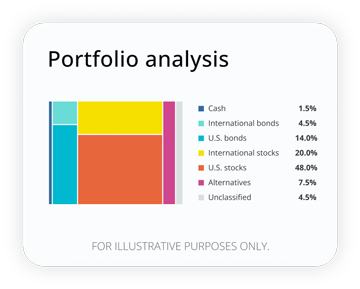
How well are your investments performing?
Analyze your portfolio in minutes and receive a target allocation for your goals.
1. Standard deduction increases for all filing statuses
The standard deduction is a fixed amount you can subtract from your income to reduce how much of it is taxed. The amount you qualify for depends on your filing status.
For tax year 2027 (which will be filed in 2028), the standard deduction rises to $33,200 for married couples filing jointly. Single taxpayers and married individuals filing separately will see a deduction of $16,600, and those filing as head of household will receive $24,925.1
Here's how the standard deduction amounts compare:
Filing status | 2026 standard deduction | 2027 standard deduction |
Married filing jointly or surviving spouse | $32,200 | $33,200 |
Single or married filing separately | $16,100 | $16,600 |
Head of household | $24,150 | $24,925 |
Taxpayers age 65 or older, or those who are blind, may also qualify for an additional standard deduction. In 2027, that amount increases to $1,700 per qualifying individual, or $2,100 for unmarried filers who aren't surviving spouses.2 Eligible taxpayers age 65 and older may also claim a separate deduction of up to $6,000, subject to income limits.3
2. New inflation-adjusted federal income tax brackets roll out
Each year, the IRS adjusts the nation’s tax brackets upward to account for the impact of inflation. This also helps to prevent “bracket creep” from nominal wage increases. While the seven federal income tax rates remain unchanged, ranging from 10% to 37%, the income thresholds are increasing.
For 2027, the top tax rate of 37% will apply to single filers with taxable income above $661,375, up from $640,600 in 2026. For married couples filing jointly, the top bracket begins above $793,650, compared with $768,700 in 2026.4
The other 2027 tax brackets for single filers are:
- 35% for taxable income over $264,550
- 32% for taxable income over $208,325
- 24% for taxable income over $109,125
- 22% for taxable income over $52,025
- 12% for taxable income over $12,800
- 10% for taxable income of $12,800 or less
Because the U.S. uses a progressive tax system, taxpayers only pay the higher rate on the portion of their income that falls within each bracket. The higher thresholds could help reduce federal income taxes for some taxpayers, even if their income stays the same.
3. Contribution limits rise for 401(k)s, IRAs, and HSAs
Retirement savers can set aside more money in 2027 as the IRS raises contribution limits for workplace retirement plans and health savings accounts (HSAs).
Here's what's changing for 2027:
- 401(k), 403(b), and 457 contributions: The annual limit increases to $25,500, up from $24,500 in 2026.5
- Catch-up contributions: Workers ages 50 and older can contribute an additional $8,500, while those ages 60 through 63 can contribute an extra $11,750.
- IRA contributions: The annual limit remains $7,500, with an additional $1,100 allowed for savers age 50 and older.
- HSA contributions: Limits increase to $4,500 for self-only coverage and $9,000 for family coverage, up from $4,400 and $8,750, respectively.6
Higher earners will also face updated workplace retirement plan catch-up contribution rules. In 2027, workers whose 2026 wages from their employer exceeded $155,000 in Social Security wages generally must make workplace plan catch-up contributions on a Roth, or after-tax, basis rather than a pre-tax basis.7
4. New Saver’s Match program begins in 2027
A new federal retirement savings match is set to replace the Saver's Credit for eligible retirement plan and IRA contributions beginning in 2027, giving eligible lower- and moderate-income workers another way to build retirement savings.
Under the Saver's Match program, the federal government will match 50% of eligible retirement contributions, up to $2,000 per person. That means qualifying savers could receive up to $1,000 annually, deposited into an eligible retirement account rather than received as a tax credit.
The match will be subject to income limits and other eligibility requirements. Unlike the Saver's Credit, which reduces federal income taxes owed, the new program is designed to help eligible workers grow their retirement savings directly.
The Saver's Match applies to qualifying contributions made beginning in 2027, with the first matching contributions generally expected after taxpayers file their 2027 returns in 2028.8
5. Student loan interest deduction income limits rise
More student loan borrowers may qualify for a tax break in 2027 as the IRS raises the income limits for deducting interest paid on qualifying loans.
The deduction allows eligible taxpayers to subtract up to $2,500 in student loan interest from their taxable income, even if they don't itemize deductions.
For 2027, the income thresholds are increasing:
- Single filers: The deduction begins to phase out at $90,000 in modified adjusted gross income (MAGI) and disappears at $105,000.
- Married couples filing jointly: The deduction begins to phase out at $180,000 in MAGI and disappears at $210,000.
The higher thresholds could allow some borrowers who previously earned too much to qualify for the deduction to claim at least a portion of it in 2027.9
6. Capital gains tax thresholds increase
Investors may be able to realize more investment gains at lower tax rates in 2027 as the IRS raises income thresholds for long-term capital gains.
The federal tax rates remain at 0%, 15%, and 20%, but the income thresholds are increasing. For 2027, the 0% capital gains rate applies to taxable income up to:10
- Single filers: $51,050
- Married couples filing jointly: $102,100
- Heads of household: $68,350
Long-term gains above those thresholds are generally taxed at 15% or 20%, depending on taxable income. Short-term gains are taxed at ordinary income tax rates.
7. Child Tax Credit increases for 2027
Families with qualifying children could see a bigger tax break in 2027 as the IRS raises the maximum Child Tax Credit.
The credit increases to $2,300 per qualifying child, up from $2,200 in 2026. The refundable portion also rises to $1,800, meaning eligible families could receive money back even if they owe little or no federal income tax.11
The credit begins to phase out for taxpayers with modified adjusted gross income (MAGI) above $200,000, or $400,000 for married couples filing jointly.
8. Estate and gift tax exclusions increase
Taxpayers planning to transfer wealth to family members or other beneficiaries may benefit from higher estate and gift tax exclusions in 2027.
The federal estate tax exclusion increases to $15.48 million per individual, up from $15 million in 2026. This allows more assets to pass to beneficiaries without triggering federal estate taxes, depending on prior taxable gifts and other factors.
The annual gift tax exclusion also rises to $20,000 per recipient, up from $19,000 in 2026. Married couples can generally give up to $40,000 per recipient without using their lifetime gift tax exemption, provided both spouses qualify and applicable rules are met.12
1 IRS, "Revenue Procedure 2026-35," November 2026.
2 IRS, "Revenue Procedure 2026-35," November 2026.
3 IRS, "2026 filing season updates and resources for seniors," February 2026.
4 IRS, "IRS releases tax inflation adjustments for tax year 2027; taxpayers continue to benefit from the Working Families Tax Cuts," November 2026.
5 IRS, "401(k) limit increases to $25,500 for 2027, IRA limit remains $7,500," November 2026.
6 IRS, "Revenue Procedure 2026-24," June 2026.
7 IRS, "Notice 2026-66," November 2026.
8 IRS, "Saver's Match," November 2026.
9 IRS, "Revenue Procedure 2026-35," November 2026.
10 Ibid.
11 IRS, "IRS releases tax inflation adjustments for tax year 2027; taxpayers continue to benefit from the Working Families Tax Cuts," November 2026.
12 IRS, "IRS releases tax inflation adjustments for tax year 2027; taxpayers continue to benefit from the Working Families Tax Cuts," November 2026.
RO6116208-1126
 Get The Currency newsletter




The Currency editors
Staff contributors
The CurrencyTM writers and editors cover the latest financial news and insights shaping how we live, work, and play. The team provides accurate, data-driven, and timely content aimed at empowering financial freedom for all.
The content contained in this blog post is intended for general informational purposes only and is not meant to constitute legal, tax, accounting or investment advice. You should consult a qualified legal or tax professional regarding your specific situation. No part of this blog, nor the links contained therein is a solicitation or offer to sell securities. Compensation for freelance contributions not to exceed $1,250. Third-party data is obtained from sources believed to be reliable; however, Empower cannot guarantee the accuracy, timeliness, completeness or fitness of this data for any particular purpose. Third-party links are provided solely as a convenience and do not imply an affiliation, endorsement or approval by Empower of the contents on such third-party websites. This article is based on current events, research, and developments at the time of publication, which may change over time.
Certain sections of this blog may contain forward-looking statements that are based on our reasonable expectations, estimates, projections and assumptions. Past performance is not a guarantee of future return, nor is it indicative of future performance. Investing involves risk. The value of your investment will fluctuate and you may lose money.
Certified Financial Planner Board of Standards Inc. (CFP Board) owns the certification marks CFP®, CERTIFIED FINANCIAL PLANNER™, CFP® (with plaque design), and CFP® (with flame design) in the U.S., which it authorizes use of by individuals who successfully complete CFP Board's initial and ongoing certification requirements.