

Why QR codes show promise for instant payments
Why QR codes show promise for instant payments
QR code payments are expanding as retailers test app-based checkouts. Learn how they work, adoption hurdles, and fraud risks
Why QR codes show promise for instant payments
QR code payments are expanding as retailers test app-based checkouts. Learn how they work, adoption hurdles, and fraud risks

10.03.2025

Listen
·Why QR codes show promise for instant payments
Key takeaways:
- QR codes enable contactless payments with a quick mobile scan
- QR codes appeal to small vendors for low-cost checkout options
- Dynamic QR codes are harder to tamper with than static codes
- A uniform and tested QR standard could accelerate U.S. adoption
QR code payments let shoppers scan a square barcode with a smartphone to complete a transaction. They are expanding in retail although fraud risks and lack of a unified standard remain obstacles.
American shoppers might have noticed more retailers, restaurants, and pop-up markets placing small square barcodes next to payment card readers in recent years. The black-and-white grids are QR codes for payments, widely used abroad but still emerging in the U.S.1
QR codes, or quick response codes, are a type of bar code that's scannable by digital devices like smartphones through their camera lens. They were created in the 1990s and resurged during the pandemic as a touchless way to share information, such as digital restaurant menus or business details posted on storefronts.2
The scannable squares are now being used as an alternative to inserting or tapping a payment card, one of several technologies vying to reshape checkout habits.3
The QR payments market is expected to reach $35 billion globally by 2030, with 16% annual growth. But like other payment technologies, QR codes aren’t immune to risks like fraud or data breaches.4
How QR codes work for payments
A QR code can flow in either direction for payments, but the merchant-presented model is more common in the U.S. Under the model, retailers, restaurants, and others can display a QR code that customers scan with PayPal, Venmo, other payments and banking apps, or a phone camera.5
The codes typically include details such as the account, amount, or an order number. Once confirmed by the user, they are sent through existing payment networks to transfer funds nearly instantly.6
The codes are often popular with small vendors that don’t want to invest in card readers and other point-of-sale equipment.7 Several retailers are also experimenting with QR codes at checkout, including Walmart, Amazon, and others.8
QR codes in the U.S.
Empower research shows more than half of Americans using digital payments weekly, with the main appeal being the ability to use them anywhere (69%), making payments quick and seamless (66%) and conveniently contactless (59%).
While popular in Asia, Latin America, and other parts of the world, QR codes for payments do face different competitive hurdles in the U.S.9,10
Tapping a card — or a digital wallet linked to a card — at checkout are very popular with American shoppers and many merchants have built their payment terminals and systems around card networks.11
Near-field communication (NFC), the short-range wireless technology that transfers contactless payments between digital wallets and checkout terminals, is often seamless and convenient. QR code payments are quick but different; they require launching an app, scanning a code in a camera, and confirming payment. They also often depend on a store’s wireless network.12
Consumers also might stick with more traditional credit or debit cards because of greater familiarity or upgraded technologies like EMV chips that allow contactless card transactions.13
But QR codes have appeal for low merchant costs and flexibility. Unlike NFC, which requires special terminals, they can be printed or displayed on a screen, letting small shops and pop-up vendors accept payments with nothing more than a smartphone camera.14
Read more: Small businesses: Putting themselves on the map
A uniform standard for QR payments
Another major hurdle for QR codes in the U.S. has been a patchwork system of QR code presentation models. A Venmo code won’t work with PayPal, and a merchant using Cash App may need a different set up than one tied to a bank wallet.15
But that’s changing. The industry has been developing a unified QR standard that would let any code be scanned by any app. The uniform approach was recently tested on FedNow, the Federal Reserve’s instant payment service that allows banks and credit unions to move money instantly 7 days a week, 24 hours a day.16
If adopted, a uniform standard would let QR codes securely encode all the details needed for a payment without exposing customer account information.17
How consumers can stay safe with QR payments
Greater standardization could also help address fraud concerns. The Federal Trade Commission and several states have issued warnings about “quishing,” a tactic in which criminals place fake QR codes over legitimate ones.18
Shoppers who scan an altered code may unknowingly send money to a scammer or be redirected to a malicious website designed to steal account credentials. Because QR codes can look alike, it can pose a challenge in telling the difference.19
The risk can be greater with static QR codes, the kind printed on signs or receipts that never change. By contrast, dynamic QR codes refresh for every transaction and include specific payment details like the amount and order number, making them harder to tamper with.20
Some industry groups are pushing for broader use of dynamic codes and for embedding digital signatures to verify QR authenticity.21
Consumers can also take steps to protect themselves. Cybersecurity professionals recommend only scanning codes from trusted sources. Consumers should also verify the URL in a QR code to make sure it looks legitimate before entering any personal or account details.22
Read more: How to be smart in a digital society
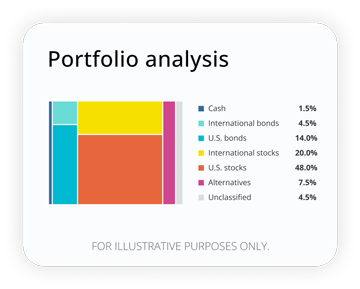
How well are your investments performing?
Analyze your portfolio in minutes and receive a target allocation for your goals.
1 Consumer Financial Protection Bureau, “Big Tech's Role in Contactless Payments: Analysis of Mobile Device Operating Systems and Tap-to-Pay Practices,” September 2023.
2 Forbes, “How The Pandemic Saved The QR Code From Extinction,” September 2021.
3 Consumer Financial Protection Bureau, “Big Tech's Role in Contactless Payments: Analysis of Mobile Device Operating Systems and Tap-to-Pay Practices,” September 2023.
4 CBC, “Is that QR code actually a scam? Here's what to know about 'quishing' before you scan,” July 2025.
5 U.S. Chamber of Commerce, “What Are QR Code Payments? July 2024.
6 Stripe, “QR code payments: How businesses can generate and use QR codes,” June 2025
7 Deloitte, “Digital payment technology for merchants,” July 2023
8 U.S. Chamber of Commerce, “Marketers from Kellogg to Walmart Optimize QR Codes to Drive Consumer Engagement and Sales,” April 2022.
9 World Bank, “The use of quick response codes in payments,” September 2021.
10 Juniper Research, “QR Code Payments: Market Expansion and High-growth Areas,” August 2023.
11 Consumer Financial Protection Bureau, “Big Tech's Role in Contactless Payments: Analysis of Mobile Device Operating Systems and Tap-to-Pay Practices,” September 2023.
12 Consumer Financial Protection Bureau, “Big Tech's Role in Contactless Payments: Analysis of Mobile Device Operating Systems and Tap-to-Pay Practices,” September 2023.
13 Federal Reserve Bank of Atlanta, “Consumer Survey Finds Credit Cards at Top of Wallet,” June 2024
14 Forbes, “Taking Advantage Of Three Major Developments In QR Code Payment,” October 2024.
15 Faster Payments Council, “Overcoming Instant Payment QR Code Impediments to Adoption: Usability,” March 2025.
16 Digital Transactions, “QR Codes Make a Splash in the Real Time Payments Pool,” July 2025.
17 Digital Transactions, “QR Codes Make a Splash in the Real Time Payments Pool,” July 2025.
18 Financial Times “Banks and regulators warn of rise in ‘quishing’ QR code scams,” October 2024
19 CNBC, “‘Quishing’ scams dupe millions of Americans as cybercriminals turn the QR code bad,” July 2025
20 Faster Payments Council, “How QR Codes Address ‘the Last Mile’ Adoption of Faster Payments at the Point-of-Sale” April 2024.
21 Faster Payments Council, “How QR Codes Address ‘the Last Mile’ Adoption of Faster Payments at the Point-of-Sale” April 2024.
22 CNBC, “‘Quishing’ scams dupe millions of Americans as cybercriminals turn the QR code bad,” July 2025
RO4869753-1025
 Get The Currency newsletter


The Currency editors
Staff contributors
The CurrencyTM writers and editors cover the latest financial news and insights shaping how we live, work, and play. The team provides accurate, data-driven, and timely content aimed at empowering financial freedom for all.
The content contained in this blog post is intended for general informational purposes only and is not meant to constitute legal, tax, accounting or investment advice. You should consult a qualified legal or tax professional regarding your specific situation. No part of this blog, nor the links contained therein is a solicitation or offer to sell securities. Compensation for freelance contributions not to exceed $1,250. Third-party data is obtained from sources believed to be reliable; however, Empower cannot guarantee the accuracy, timeliness, completeness or fitness of this data for any particular purpose. Third-party links are provided solely as a convenience and do not imply an affiliation, endorsement or approval by Empower of the contents on such third-party websites. This article is based on current events, research, and developments at the time of publication, which may change over time.
Certain sections of this blog may contain forward-looking statements that are based on our reasonable expectations, estimates, projections and assumptions. Past performance is not a guarantee of future return, nor is it indicative of future performance. Investing involves risk. The value of your investment will fluctuate and you may lose money.
Certified Financial Planner Board of Standards Inc. (CFP Board) owns the certification marks CFP®, CERTIFIED FINANCIAL PLANNER™, CFP® (with plaque design), and CFP® (with flame design) in the U.S., which it authorizes use of by individuals who successfully complete CFP Board's initial and ongoing certification requirements.