

Making sense of the mega backdoor Roth
Making sense of the mega backdoor Roth
How a mega backdoor Roth can boost retirement savings
Making sense of the mega backdoor Roth
How a mega backdoor Roth can boost retirement savings

12.23.2025
Key takeaways
A mega backdoor Roth uses after‑tax 401(k) contributions plus a rollover to a Roth account so high earners can add more to Roth savings when they exceed regular income limits.
Your 401(k) must allow after‑tax contributions and either in‑service withdrawals to a Roth IRA or in‑plan Roth conversions for this strategy to be available.
In 2026, the 401(k) elective deferral limit is $24,500 and the overall defined contribution plan limit is $72,000, so any remaining space under that cap may be available to be used for mega backdoor Roth contributions.
In 2025 and 2026, high earners who are over the Roth IRA income limits may still be able to move extra after‑tax dollars into a Roth account using a “mega backdoor Roth” strategy if their workplace 401(k) plan has the right features. For 2026, the IRS sets a $24,500 elective deferral limit for 401(k) plans and a $72,000 overall annual limit on total employee and employer contributions to defined contribution plans, which helps determine how much may flow through this strategy.
Roth IRAs are a great tool for retirement savers.
They enable individuals to enjoy tax-free qualified withdrawals of their money after they retire, or even earlier in some situations. This can help retirees stretch their savings even further.
But there’s one big catch when it comes to Roth IRAs.
If you earn too much money, you can’t contribute to one.
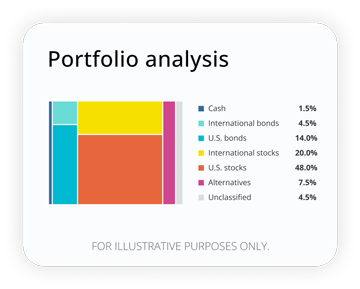
How well are your investments performing?
Analyze your portfolio in minutes and receive a target allocation for your goals.
Roth IRA income limits in 2025 and 2026
Your ability to contribute to a Roth IRA is phased out as your modified adjusted gross income (MAGI) increases. In 2025, the Roth IRA contribution phase-out range runs from $150,000 to $165,000 for single filers and heads of household and from $236,000 to $246,000 for married couples filing jointly; you cannot contribute once your MAGI is at or above the top of these ranges.1 In 2026, the phase-out range rises to $153,000 to $168,000 for single filers and heads of household and $242,000 to $252,000 for married couples filing jointly; again, no Roth IRA contributions are allowed once your MAGI reaches the top of the range.2
But there’s good news. You can still reap the benefits of a Roth account even if your income exceeds these limits by using a technique known as a “mega backdoor” Roth. This strategy may enable you to sock away tens of thousands of dollars more for retirement in a single year.
How does a mega backdoor Roth work?
Here’s how the process works. If you can check the box on each of the following conditions, then you may qualify for a mega backdoor Roth IRA.
Determine the maximum after-tax contribution you can make to your traditional 401(k) account. Make that contribution.
Roll over or convert this amount to a Roth IRA or Roth account in your 401(k). Unlike with a normal Roth IRA conversion, the principal will not be taxable. However, the earnings portion of the rollover will be considered pretax and subject to taxation at the time of conversion. Consider all your options and their features and fees before moving money between accounts.
Are you eligible?
You can only perform a mega backdoor Roth under the following conditions.
You participate in a 401(k) plan at work that allows after-tax contributions. Regular 401(k) contributions are made on an elective deferral, or pretax, basis. Not all plans allow after-tax contributions, so check with your benefit plan administrator before moving forward. In addition, your ability to make after-tax contributions may be limited by IRS non-discrimination rules that apply to highly compensated employees.
The 401(k) plan allows in-service distributions to a Roth IRA or transfer of funds out of the after-tax portion of the account into a Roth account. If it doesn’t, you’ll have to wait until after you leave the company to perform a mega backdoor Roth.
How much can you contribute?
With a mega backdoor Roth, for 2025, total employee and employer contributions to a defined contribution plan such as a 401(k) generally cannot exceed $70,000, and for 2026 the overall limit increases to $72,000; these caps include your elective deferrals, any employer match or profit sharing, and any after-tax contributions. In 2025 and 2026, your own elective 401(k) deferrals are also subject to separate annual limits — $23,500 in 2025 and $24,500 in 2026 — within those overall caps. A mega backdoor Roth uses any remaining room under those overall limits, after your regular contributions and employer contributions, for extra after-tax dollars that you then roll into a Roth IRA or Roth account within your 401(k).
If you have access to a Roth 401(k) plan at work, you can decide whether to roll over the funds into this Roth 401(k) plan or a separate Roth IRA. If your employer only offers pre-tax 401(k) contributions, then you’ll roll over the funds into a Roth IRA.
The bottom line: If you are unable to contribute to a Roth IRA because you earn too much money, or if you still have money left over to save for retirement after maxing out your traditional 401(k) and IRA, then a mega backdoor Roth might be a smart strategy for you.
The details in performing a mega backdoor Roth can be complex, so you should consult with your 401(k) plan administrator and your financial and tax advisors for guidance in your situation.
Frequently asked questions about mega backdoor Roth strategies
What is a mega backdoor Roth?
It’s a strategy where you make after‑tax contributions to a 401(k) and then move those dollars into a Roth IRA or Roth account in your 401(k), letting more money end up in Roth than regular annual limits alone would allow.
Who might consider a mega backdoor Roth?
It’s generally most useful for high earners who already max out regular 401(k) and IRA contributions and expect to be in a similar or higher tax bracket in retirement.
How do 2026 contribution limits affect mega backdoor Roth amounts?
In 2026, elective 401(k) deferrals are capped at $24,500 and total annual defined contribution plan additions are limited to $72,000, so your available mega backdoor space depends on how much you and your employer already contribute and your eligibility to make after-tax contributions to the plan.
Does a mega backdoor Roth change my regular Roth IRA contribution limits?
No. The mega backdoor Roth uses your workplace plan’s after‑tax contribution space; your separate Roth IRA contribution eligibility still depends on your MAGI and the annual IRA contribution limits for the year.
Are mega backdoor Roth conversions taxable?
The after‑tax principal you convert is generally not taxable, but any pretax earnings in the account are taxable in the year of conversion, so it’s important to review your situation with a tax professional.
What if my 401(k) plan doesn’t allow after‑tax contributions?
You cannot use a mega backdoor Roth in that plan; you may still consider other strategies, such as a standard backdoor Roth IRA, if they fit your situation and eligibility rules.
1 IRS, “2025 Amounts Relating to Retirement Plans and IRAs, as Adjusted for Changes in Cost-of-Living,” Accessed December 2025.
2 IRS, “2026 Amounts Relating to Retirement Plans and IRAs, as Adjusted for Changes in Cost-of-Living,” Accessed December 2025.
RO5078735-1225
 Get The Currency newsletter



The Currency editors
Staff contributors
The CurrencyTM writers and editors cover the latest financial news and insights shaping how we live, work, and play. The team provides accurate, data-driven, and timely content aimed at empowering financial freedom for all.
The content contained in this blog post is intended for general informational purposes only and is not meant to constitute legal, tax, accounting or investment advice. You should consult a qualified legal or tax professional regarding your specific situation. No part of this blog, nor the links contained therein is a solicitation or offer to sell securities. Compensation for freelance contributions not to exceed $1,250. Third-party data is obtained from sources believed to be reliable; however, Empower cannot guarantee the accuracy, timeliness, completeness or fitness of this data for any particular purpose. Third-party links are provided solely as a convenience and do not imply an affiliation, endorsement or approval by Empower of the contents on such third-party websites. This article is based on current events, research, and developments at the time of publication, which may change over time.
Certain sections of this blog may contain forward-looking statements that are based on our reasonable expectations, estimates, projections and assumptions. Past performance is not a guarantee of future return, nor is it indicative of future performance. Investing involves risk. The value of your investment will fluctuate and you may lose money.
Certified Financial Planner Board of Standards Inc. (CFP Board) owns the certification marks CFP®, CERTIFIED FINANCIAL PLANNER™, CFP® (with plaque design), and CFP® (with flame design) in the U.S., which it authorizes use of by individuals who successfully complete CFP Board's initial and ongoing certification requirements.