

What to know about 401(k) rollover options
What to know about 401(k) rollover options
A 401(k) rollover moves funds to a new plan or IRA. Cashing out early can trigger taxes and penalties, while direct rollovers avoid taxation and mandatory 20% tax withholding
What to know about 401(k) rollover options
A 401(k) rollover moves funds to a new plan or IRA. Cashing out early can trigger taxes and penalties, while direct rollovers avoid taxation and mandatory 20% tax withholding

09.11.2026
Key takeaways
- A 401(k) rollover is the transfer of money from your 401(k) plan account to a new employer-sponsored retirement plan or an IRA.
- Cashing out early can trigger taxes and penalties, including a 10% tax penalty for those younger than age 59½, unless an exception applies. Eligible rollover distributions paid directly to you are generally subject to 20% federal income tax withholding.
- In most cases, you may also choose to leave money in your old 401(k) plan until retirement or if you hold employer stock in the plan, consider whether special net unrealized appreciation (NUA) tax treatment may apply to a distribution of that stock.
Rolling over a 401(k) means transferring your retirement savings from an old employer plan to a new one or to an IRA. However, cashing out may lead to income taxes and early withdrawal penalties. Compare costs and tax implications before making a move. You can also choose to leave your money in your former employer’s plan if permitted under your plan.
Rolling over your 401(k) means transferring money from your former employer-sponsored retirement plan into another employer-sponsored retirement plan or an individual retirement account (IRA).
Leaving your job is a big life change, so it makes sense that your employer-sponsored 401(k) may not be immediately top-of-mind. You’re likely finding your feet at your new job, sorting through administrative tasks and absorbing new information during company onboarding. It can be an overwhelming time. But you may want to consider 401(k) rollover options.
Read more: What happens to your 401(k) if you quit?
Below we cover different approaches to the 401(k) rollover and how to transfer a 401(k).
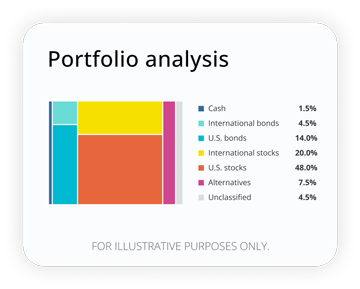
How well are your investments performing?
Analyze your portfolio in minutes and receive a target allocation for your goals.
401(k) rollover options
After leaving a job, you have several options when it comes to your employer-sponsored 401(k) plan, including:
- Leave money in your old plan. This is the simplest option — essentially doing nothing and leaving your 401(k) funds where they are. (In some cases, balances under $7,000 may be automatically forced out of the plan). Any unvested employer contributions may be forfeited according to the plan’s terms.
- Roll funds to an Individual Retirement Account (IRA). You’ll need to open a new IRA if you don’t currently have one. If you do have an IRA, you can roll your 401(k) money over into it.
- Roll into your new employer’s plan. If your new employer offers a retirement plan, such as a 401(k), this might be a good option because it will enable you to keep your retirement savings all in one place.
- Cash out all your 401(k). Here, you’ll take a taxable lump-sum distribution from your old 401(k) account. If you’re younger than age 59½, you’ll potentially have to pay an additional 10% tax penalty.
- Cash out a portion of your 401(k). Alternatively, you could distribute some of your 401(k) money, pay the taxes and penalties that are due, and roll over the rest into an IRA or your new employer’s retirement plan. Portions of your 401(k) invested in company stock may be subject to NUA rules, which can potentially lower taxes on distributions.
A common misconception about 401(k) plans is that if you leave your funds in the account after leaving the employer, you will continue to receive matching contributions or continue to vest the previously added match. That’s not the case, however. Not only will you not receive any matching contributions, but you also won’t be able to contribute to your old 401(k) at all.
Read more: How to find old 401(k) accounts
There may be specific scenarios when a taxable distribution might make sense, such as if you own stock in your company in your 401(k). Additionally, some scenarios may cause high-income earners to encounter a taxable situation when attempting a backdoor Roth conversion after rolling over a 401(k) into an IRA. If you think this might apply to you, consider talking with a financial advisor or other financial professional about your rollover options.
Consider all your options, including taxes, fees and expenses, before moving money between accounts. Assess all benefits of current accounts before moving money.
Things to consider before rolling over your 401(k) to an IRA
1. Difference in fees
401(k)s can cost more or less than IRAs. First, 401(k)s typically have administrative fees. These are in place to cover the day-to-day operations of a 401(k), including record-keeping, accounting, legal and trustee services. In addition, 401(k) investment options can sometimes be more expensive than other investments available outside of a 401(k).
It’s important to review the administrative and investment fees for both types of accounts before making a decision, so it’s important to understand the fees associated with your specific plan.
Our free Fee Analyzer will tell you what impact fees might have on your retirement goals.
2. Investment options
The second thing to consider before rolling your 401(k) over into an IRA is the available investment selections. IRAs typically offer a wide range of investment options which may include exchange-traded funds (ETFs), bonds, mutual funds or individual stocks. Whereas 401(k) plan investment options may be more limited. You should review and compare the available investment options before making a decision.
Your investment time horizon and risk tolerance, along with several other factors, can ultimately help guide your decision.
You can use the Empower Investment Checkup tool to help determine your target allocation and see how your existing portfolio compares.
Finally, when you make trades within either a 401(k) plan or an IRA, you can do so without generating a reportable event to the IRS. Think of it this way: When you sell shares, you’re not taking a distribution, and you’re not making a contribution when you use the proceeds to reinvest.
Cashing out your 401(k)
As explained above, you can cash out all or part of your 401(k) if you want. However, it may be a poor financial decision to cash out your 401(k) if you are younger than 59½ due to the current taxation and additional 10% penalty that will be assessed.
However, if a portion of your 401(k) is invested in company stock, then taking that portion as a taxable distribution could make sense. The reason? Company stock has different tax treatment if it’s taken out as part of a lump sum distribution from a 401(k). Typically, whether you withdraw money from a 401(k) as a lump sum distribution or as income during retirement, you pay tax on all your 401(k) withdrawals at ordinary income rates. Gains that came from appreciation and income, therefore, have the same tax treatment.
Company stock, on the other hand, can be distributed as shares “in-kind” from a 401(k) as part of a lump sum distribution and the ordinary income tax rate will be applied only to the cost basis of the stock. Any growth in your company stock is considered “net unrealized appreciation,” or NUA. You’ll only pay tax on your NUA once you sell the stock, and if you sell it a year after taking the lump sum distribution, you’ll be taxed at long-term capital gains rates.
One important requirement that must be met as part of the NUA rules is that the distribution must be part of a lump sum distribution of your account from the plan, meaning that you must distribute the entirety of your plan’s vested balance within one year.
The NUA strategy must be vetted carefully and is not for everyone, so consider consulting your financial and tax professionals before moving forward.
How to roll over your 401(k) to an IRA
To rollover your 401(k) to an IRA, follow these steps:
- Open an IRA if you don’t have one.
- Inform your former employer that you want to roll over your 401(k) funds into an IRA. Make sure the check is payable to the financial services company fbo your IRA, instead of you personally — this is referred to as a direct rollover. Direct rollovers help ensure you avoid taxation and the automatic 20% withholding for taxes. Otherwise, 20% of the money will automatically be withheld to pay taxes.
- Once the transfer is complete, you can decide how to invest the money to achieve your retirement goals. Everyone’s asset allocation will be different based on their goals, time horizon and risk tolerance — there’s no cookie-cutter approach to retirement investing.
Frequently asked questions
What is a rollover in a 401(k)?
A rollover in a 401(k) means moving funds from a 401(k) to an IRA or another 401(k).
Do you lose money when you roll over a 401(k)?
When you roll over your 401(k) money to an IRA or another 401(k), you transfer the vested balance you’ve accumulated in your old 401(k) to your IRA or new 401(k). With a direct rollover, you can also avoid the 20% tax withholding. Once your funds are rolled over, this money will maintain its tax-deferred status until you withdraw it. If rolled into a Roth account, different tax treatment may apply.
RO5886534-0926
 Get The Currency newsletter



Brian Cocos, CFP®
Contributor
Brian Cocos is a Portfolio Optimization Associate at Empower. A CERTIFIED FINANCIAL PLANNER™ professional, he works with clients to help them achieve their best financial outcomes.
The content contained in this blog post is intended for general informational purposes only and is not meant to constitute legal, tax, accounting or investment advice. You should consult a qualified legal or tax professional regarding your specific situation. No part of this blog, nor the links contained therein is a solicitation or offer to sell securities. Compensation for freelance contributions not to exceed $1,250. Third-party data is obtained from sources believed to be reliable; however, Empower cannot guarantee the accuracy, timeliness, completeness or fitness of this data for any particular purpose. Third-party links are provided solely as a convenience and do not imply an affiliation, endorsement or approval by Empower of the contents on such third-party websites. This article is based on current events, research, and developments at the time of publication, which may change over time.
Certain sections of this blog may contain forward-looking statements that are based on our reasonable expectations, estimates, projections and assumptions. Past performance is not a guarantee of future return, nor is it indicative of future performance. Investing involves risk. The value of your investment will fluctuate and you may lose money.
Certified Financial Planner Board of Standards Inc. (CFP Board) owns the certification marks CFP®, CERTIFIED FINANCIAL PLANNER™, CFP® (with plaque design), and CFP® (with flame design) in the U.S., which it authorizes use of by individuals who successfully complete CFP Board's initial and ongoing certification requirements.