

Trump Account for kids: Eligibility, government contribution, and limits
Trump Account for kids: Eligibility, government contribution, and limits
Trump Accounts are investment accounts that can help kids build long-term retirement savings. Learn how they work, including eligibility, contributions, withdrawals, and taxes
Trump Account for kids: Eligibility, government contribution, and limits
Trump Accounts are investment accounts that can help kids build long-term retirement savings. Learn how they work, including eligibility, contributions, withdrawals, and taxes

10.12.2026
Key takeaways
- Trump Accounts are a custodial type of tax-advantaged traditional IRA for eligible children under age 18 with a Social Security number.
- The Treasury Department has automatically opened Trump Accounts for most eligible children. A parent or guardian still needs to claim the account before they can manage it.
- Eligible U.S. citizen children born from 2025 through 2028 may receive a one-time $1,000 federal contribution. A separate election is required to receive it.
Trump Accounts (formally known as Section 530A accounts) are a new type of traditional individual retirement account (IRA) designed to help children build wealth from an early age. With tax advantages and low investment fees, these accounts can provide a cost-effective way to invest in your child’s future.
What is a Trump Account for kids?
A Trump Account is an investment account geared toward helping kids build long-term retirement savings. These custodial-style accounts are owned by the child but managed by a parent or legal guardian until the minor turns 18. Parents, guardians, and other eligible adults may contribute to the account, while the custodian is authorized to act on the child's behalf during the growth period.1
The U.S. Treasury Department has automatically created Trump Accounts for most eligible children under age 18 with a Social Security number. A parent or guardian must claim the account before they can manage it and make contributions.2
Parents and others can contribute up to $5,000 annually for each eligible child in 2026 and 2027. Children born between 2025 and 2028 may also qualify for a one-time federal contribution of up to $1,000, which doesn't count toward the limit.3 A separate election is required to receive the federal contribution.4
How well are your investments performing?
Analyze your portfolio in minutes and receive a target allocation for your goals.
Who qualifies for a Trump Account?
Any child under age 18 with a Social Security number may be eligible for a Trump Account.5 Unlike a typical traditional IRA, Trump Accounts do not require account holders and contributors to have earned income. The Treasury Department has automatically created accounts for most eligible children.6
Certain children may also qualify for a one-time $1,000 government contribution under the new pilot program. To be eligible, a child must:7
- Be born between January 1, 2025, and December 31, 2028
- Be a U.S. citizen
- Have an authorized individual make a separate election for the $1,000 contribution
How to open or claim a Trump Account for kids or a baby
The Treasury Department has automatically opened Trump Accounts for most eligible children under age 18 with a Social Security number. Parents and legal guardians should first check whether an account has already been opened for their child.
The child for whom the account is opened is both the legal owner and the beneficiary of the Trump Account. Each child may have only one Trump Account.
Here are the steps to check for, claim, or open a Trump Account:
- Check whether your child already has a Trump Account: Start the claiming process through the Trump Accounts app or web portal to determine whether Treasury has automatically opened an account for your child.
- Claim the account if one has been created: Follow the claiming process to verify your identity and legal authority to act on the child's behalf, review the child's information, and accept the account terms.
- Open an account if one hasn't already been created: If your child doesn't have a Trump Account, an authorized individual can elect to open one by filing IRS Form 4547. You can do this through your tax filing, or by visiting the official trumpaccounts.gov website.
- Elect the $1,000 federal contribution, if eligible: A separate election is required for an eligible child to receive the one-time $1,000 federal contribution.
- Fund the account: Parents, family members, employers, and other eligible individuals can contribute funds to the account up to the annual limits.
- Manage the account in the long-term: You can continue contributing each year, subject to the annual limits. Contributions will be automatically invested in a default index fund option after the account is launched.8 The Treasury intends to provide future guidance on transferring a Trump Account to an eligible financial institution of your choice through a trustee-to-trustee transfer.9
Trump Account contribution limits
Up to $5,000 can be contributed per child to a Trump Account in 2026 and 2027. This combined annual total includes all contributions made by parents, relatives, friends, employers, and even children themselves as they get older. It does not, however, include the initial government seed contribution, if eligible, or any philanthropic contributions. Contribution limits will be subject to cost-of-living adjustments for future tax years.10
Individual contributions are made on an after-tax basis. Employers may also offer payroll deductions for employee contributions or make up to $2,500 in employer-funded contributions annually per employee through a qualifying program. The employer contribution limit may be allocated among the employee's eligible children.11
For example, Jane has two children — a baby born in January 2026 and a five-year-old. Jane claims the Trump Accounts for her children, and separately elects the $1,000 federal contribution for her eligible baby.
Jane’s employer contributes $1,250 to each child’s account, for a total of $2,500. Jane can then contribute $3,750 to each of her children’s accounts before hitting the contribution limit of $5,000, excluding the federal seed contribution to the baby.
| Baby | Child |
Government contribution | $1,000 | Ineligible |
Employer contribution | $1,250 | $1,250 |
Jane’s contribution | $3,750 | $3,750 |
Total contributions for 2026 | $6,000 | $5,000 |
Read more: Average retirement savings by age | Empower
What investments are available in a Trump Account?
Contributions to a Trump Account are initially invested in the State Street SPDR Portfolio S&P 500 ETF (SPYM), a low-cost exchange-traded fund (ETF) that tracks the S&P 500 Index. Annual fees and expenses are capped at 0.1% of the balance of the investment or less. The Treasury Department plans to make add index fund options for parents to choose from in the future.12
Saving in Trump accounts must remain invested in a diversified index fund of U.S. stocks during the growth period. However, an exception allows qualifying philanthropic donors to contribute eligible publicly traded stocks directly to Trump Accounts during the growth period. Investment restrictions are lifted from Trump Accounts at the beginning of the calendar year that the child turns age 18.13,14 If funds are left in the account, the special investment restrictions that apply during the growth period generally cease to apply, and traditional IRA rules generally apply.15
What happens once the child turns 18?
When the child turns 18, they can:
- Leave the money in the Trump Account, which will become subject to general IRA rules.
- Rollover or transfer some or the entire balance to another retirement account, such as a traditional IRA or another eligible retirement account.
- Convert the account to a Roth IRA or Roth 401(k), known as a Roth conversion.
Before moving funds into a new account, the child should consider how each option would fit into their long-term savings goals and should compare factors such as taxes and fees, investment options, and other account features before making a decision.
If a Trump Account hasn't been claimed by the time the child turns 18, it remains open and converts to a traditional IRA in the child's name.16
When can you take withdrawals from a Trump Account?
Withdrawals from a Trump Account are restricted until the child turns 18 years of age. After this, they are generally subject to the same rules as traditional IRAs.17 This means withdrawals before age 59½ are generally subject to income tax and a 10% penalty unless they meet certain exceptions, including:18
- Higher education expenses
- The purchase or construction of a first home (up to $10,000)
- Birth or adoption expenses (up to $5,000 per child)
- Emergency personal expenses (up to $1,000 per year)
- Qualifying medical expenses
However, the following types of withdrawals may take place at any time, regardless of the child’s age:19
- Qualified rollover contributions
- Qualified ABLE rollover contributions
- Distributions of excess contributions
- Distributions upon death of the account beneficiary
How are withdrawals from a Trump Account taxed at retirement?
Beginning at age 59½, withdrawals from a Trump Account are generally taxed according to how they were contributed. This includes withdrawals of:
- Government contributions: The initial $1,000 contribution for eligible children will be taxable when withdrawn.
- Individual contributions: After-tax contributions made by the child’s parents or another adult are not taxable when withdrawn.
- Employee deferrals: Pre-tax contributions made by the child’s parents through their employer’s payroll are taxable when withdrawn.
- Employer-funded contributions: If available, contributions from a parent’s employer are made on a pre-tax basis and are taxable when withdrawn.
- Investment earnings: All earnings on investments are taxable when withdrawn.
The rate at which withdrawals are taxed depends on the account owner’s tax rate at the time of withdrawal.
Trump Accounts vs. 529s vs. custodial accounts
Parents considering a Trump Account may wonder how it compares with other savings and investment accounts for children. The table below summarizes the key differences and similarities between Trump Accounts, 529 plans, and Uniform Gifts to Minors Act (UGMA) or Uniform Transfers to Minors Act (UTMA) accounts.
Feature | Trump Accounts | 529 plan | Custodial accounts (UGMA/UTMA) |
Primary purpose | Broad long-term savings for a child (education, home, business, investing). | Education-specific savings (college and qualified K–12 expenses). | General-purpose savings and investing for a minor. |
Who owns the account | Child is the legal owner; account follows federal program rules. | Parent or adult owns the account; child is the beneficiary. | Child owns the account; adult manages it as custodian until adulthood. |
Tax treatment of any growth | Tax-advantaged growth potential under program rules; withdrawals subject to conditions. | Any earnings grow tax-free, and withdrawals are not taxed when used for qualified education expenses. | Investment income is taxable (often under kiddie-tax rules).20 |
Contribution limits | Federal seed money for eligible children; additional contributions subject to program limits. | High lifetime limits set by each state; gift-tax rules apply. | No formal contribution limits beyond gift-tax rules. |
Investment options | Limited menu of low-cost, broad index funds. | Options vary by state plan; typically age-based portfolios and mutual funds/ETFs. | Wide range of investments, depending on the custodian and investment provider. |
When funds can be accessed | Generally available to the child at retirement, with limits on early withdrawals. | Withdraw anytime for qualified education expenses; taxes and penalties for non-qualified use. Up to $35,000 of unused funds can be rolled into the beneficiary’s Roth IRA, subject to annual contribution limits. | Child gains full control at age 18–21, depending on state law. |
Free Application for Federal Student Aid (FAFSA) impact | Similar to IRA accounts, balances do not impact FAFSA calculations, though distributions do | Varies by ownership: Grandparent-owned 529s do not impact FAFSA. Parent-owned 529 assessed at a max of 5.64% of value towards Student Aid Index (SAI).21 Student-owned 529 assessed at a max of 20% of value towards SAI. | UGMA/UTMA show up as student owned and reduce financial aid eligibility by up to 20% of the account’s value annually for SAI. E.g. a $5,000 UTMA can reduce aid by $1,000. |
Read more: Investing for kids: Account options and how to start
How can a Trump Account impact your child’s savings?
Trump Accounts are designed as a long-term retirement savings vehicle. If the child keeps the money invested after age 18 — either in the Trump Account or after rolling it into another retirement account — the funds can continue to potentially grow for decades.
One possible strategy is to convert the account to a Roth IRA at age 18. Whether a Roth conversion is appropriate depends on individual circumstances and tax considerations.
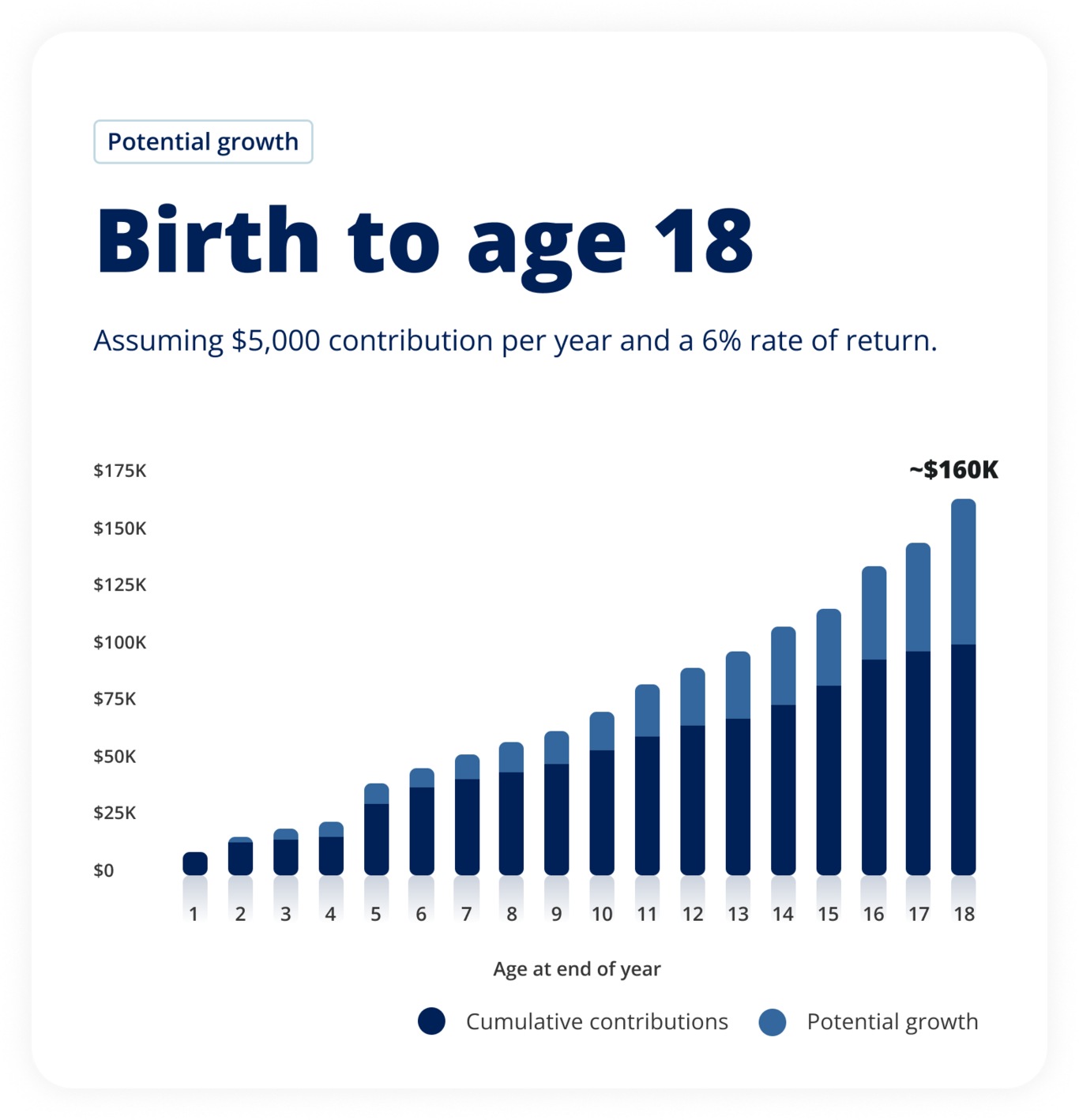
Potential growth by age 18
In this example, a child receives a $1,000 government contribution as a baby, and an additional $5,000 is contributed each year until the child reaches the age of 18. Assuming a 6% annual return, the account could potentially grow to about $160,000, including about $69,000 in investment growth.
Potential growth by retirement
In the previous example, a child receives an initial $1,000 government contribution with yearly contributions of $5,000. With an estimated 6% annual growth, the Trump Account grows to about $160,000 as the child reaches age 18. At this point, they can transfer their Trump Account funds to a Roth IRA. Their retirement savings will remain invested and can continue to grow, and they may continue contributing to the account.
When Trump Account funds are transferred to a Roth IRA, several things happen. First, the parent’s after-tax contributions (totaling $91,000) can be converted to a Roth IRA tax-free. The $69,000 in investment growth, along with the $1,000 government seed contribution, would be taxed at the child’s tax rate at that time. If the Roth account then grows at 6% annually until age 62, the balance could reach around $2.2 million, tax-free.
Read more: Roth IRA investments: A tool to help grow retirement wealth
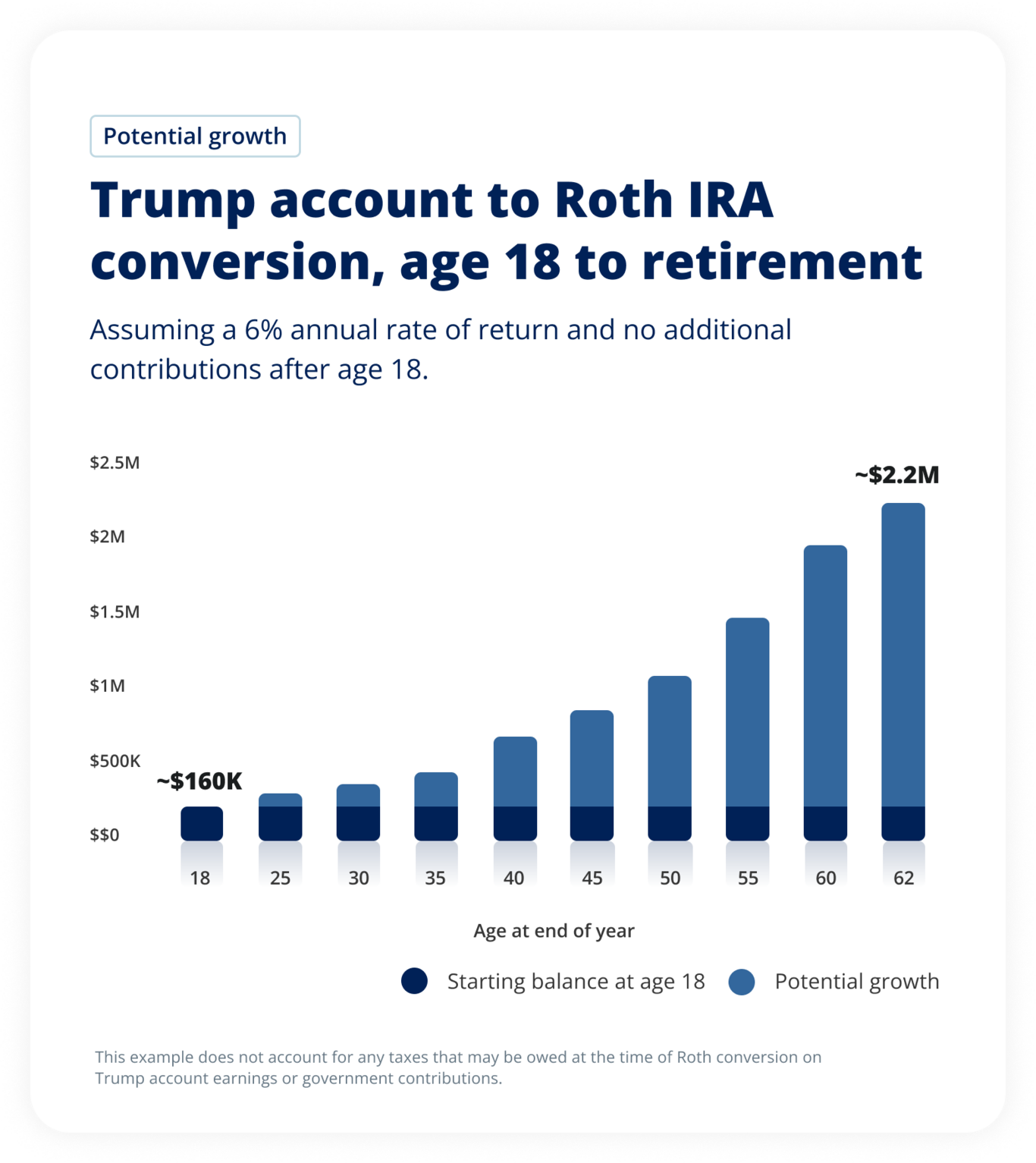
For illustrative purposes only. Actual results will vary. These hypothetical examples assume a consistent 6% annual return, do not reflect market volatility, and do not account for inflation. Investment returns are not guaranteed and may be higher or lower.
Certain rollovers to an ABLE account may be permitted, subject to IRS limits and requirements. Individuals should consult a qualified tax advisor regarding their specific situation.
1 IRS, “Notice of intent to issue regulations with respect to section 530A Trump accounts,” December 2025.
2 Department of Treasury, “Treasury Announces the Completion of Automatic Enrollment Today for Trump Accounts,” September 2026.
3 Trumpaccounts.gov, “Trump Accounts jumpstart the American Dream,” February 2026.
4 Department of Treasury, “Treasury Announces the Completion of Automatic Enrollment Today for Trump Accounts,” September 2026.
5 IRS, “Notice of intent to issue regulations with respect to section 530A Trump accounts,” December 2025.
4 U.S. Department of the Treasury, “Treasury Announces Investment Lineup for Trump Accounts,” July 2026.
5 IRS, “Notice of intent to issue regulations with respect to section 530A Trump accounts,” December 2025.
6 Department of Treasury, “Treasury Announces the Completion of Automatic Enrollment Today for Trump Accounts,” September 2026.
7 Trumpaccounts.gov, “Claim an account,” October 2026.
8 U.S. Department of the Treasury, “Treasury Announces Investment Lineup for Trump Accounts,” January 2026.
9 IRS, “Notice of intent to issue regulations with respect to section 530A Trump accounts,” December 2025.
10 Ibid.
11 Ibid.
12 U.S. Department of the Treasury, “Treasury Announces Investment Lineup for Trump Accounts,” January 2026.
13 Congress.gov, “Trump Accounts: Overview and Policy Considerations,” June 2026.
14 IRS, “Notice of intent to issue regulations with respect to section 530A Trump accounts,” December 2025.
15 Ibid.
16 Trumpaccounts.gov, “Claim an account,” October 2026.
17 IRS, “Notice of intent to issue regulations with respect to section 530A Trump accounts,” December 2025.
18 IRS, “Retirement topics - Exceptions to tax on early distributions,” December 2025.
19 IRS, “Notice of intent to issue regulations with respect to section 530A Trump accounts,” December 2025.
20 IRS, “Topic no. 553, Tax on a child's investment and other unearned income (kiddie tax),” September 2026.
21 Studentaid.gov, “What is the Student Aid Index (SAI)?” October 2026.
RO5989451-1026
 Get The Currency newsletter


The Currency editors
Staff contributors
The CurrencyTM writers and editors cover the latest financial news and insights shaping how we live, work, and play. The team provides accurate, data-driven, and timely content aimed at empowering financial freedom for all.
The content contained in this blog post is intended for general informational purposes only and is not meant to constitute legal, tax, accounting or investment advice. You should consult a qualified legal or tax professional regarding your specific situation. No part of this blog, nor the links contained therein is a solicitation or offer to sell securities. Compensation for freelance contributions not to exceed $1,250. Third-party data is obtained from sources believed to be reliable; however, Empower cannot guarantee the accuracy, timeliness, completeness or fitness of this data for any particular purpose. Third-party links are provided solely as a convenience and do not imply an affiliation, endorsement or approval by Empower of the contents on such third-party websites. This article is based on current events, research, and developments at the time of publication, which may change over time.
Certain sections of this blog may contain forward-looking statements that are based on our reasonable expectations, estimates, projections and assumptions. Past performance is not a guarantee of future return, nor is it indicative of future performance. Investing involves risk. The value of your investment will fluctuate and you may lose money.
Certified Financial Planner Board of Standards Inc. (CFP Board) owns the certification marks CFP®, CERTIFIED FINANCIAL PLANNER™, CFP® (with plaque design), and CFP® (with flame design) in the U.S., which it authorizes use of by individuals who successfully complete CFP Board's initial and ongoing certification requirements.