

Closing the planning gap in a $124 trillion transfer
Closing the planning gap in a $124 trillion transfer
Trillions are changing hands, but many households are still unprepared. New tools, workplace benefits, and shifting values could reshape how legacies are built
Closing the planning gap in a $124 trillion transfer
Trillions are changing hands, but many households are still unprepared. New tools, workplace benefits, and shifting values could reshape how legacies are built

09.08.2025

Listen
·Closing the planning gap in a $124 trillion transfer
Key takeaways
- $124 trillion will transfer across generations by 2048, yet most Americans lack an estate plan.
- Procrastination, complexity, and perceived cost remain the top barriers to planning.
- Estate planning is about protection, not just taxes, with benefits ranging from probate avoidance to peace of mind.
- Employers, technology, and cultural shifts are helping make planning more mainstream.
With new benefits, digital tools, and shifting values, estate planning is evolving from an afterthought to an essential step in securing a legacy.
The largest intergenerational wealth transfer in U.S. history is already underway, with $124 trillion expected to change hands by 2048 — $105 trillion is expected to flow to heirs, while $18 trillion will go to charity.1 But while 83% of Americans recognize the importance of estate planning, most remain unprepared: Fewer than one in three adults has a will, and participation rates are even lower among Gen X and Millennials.2
According to Empower research, more than a third of Americans still believe estate planning is only for the wealthy — even though nearly the same share say they intend to leave an inheritance regardless of income. This disconnect — called the “planning gap” — reveals a widening divide between what people think they should do and what they act on.
The planning gap, defined
If the majority see the value in estate planning, why do so few have a plan in place? Research points to three consistent barriers: Procrastination (30%), lack of knowledge (27%), and perceived cost (25%).3 And the numbers reveal just how stark the divide is: Roughly 55% of Americans have no estate plan at all.4 Among Millennials, only 22% have a will, and more than 60% lack any estate planning documents. Estate planning is less common among younger generations, with only 15% of Gen Z reporting a will.
The result is a widespread gap: Most Americans understand the need to prepare, but delay until circumstances force their hand. Estate planning is often pushed off until the death of a loved one (26%) or prompted by a health concern (21%).5
The impact of action
These barriers persist even though most estates will never trigger federal estate tax. In 2022, just 8,130 estate tax returns were filed — less than one in every 400 decedents, based on CDC mortality data — underscoring that planning today is less about taxation than about clarity and protection.6,7
At its best, planning can help families avoid probate, minimize taxes, ensure clarity in distribution, and strengthen financial security. It can also help families prepare for the possibility of incapacitation and designate guardians for minor children. Those with an estate plan say they were motivated by:8
- Peace of mind for the unexpected (50%)
- Protecting loved ones (50%)
- Providing financial security for beneficiaries (34%)
- Avoiding probate (29%)
- Ensuring personal values are upheld (22%)
The gap between recognition and action highlights the opportunity to extend the benefits of planning more widely — giving more families the peace of mind, financial security, clarity, and values-driven legacy that an estate plan can provide.
Momentum toward solutions
Signs of progress are starting to emerge. Employers are beginning to fold estate planning into benefits packages, with Gen Z and Millennials showing the strongest demand.9 According to Empower research, 41% of younger adults have worked with or plan to work with a professional, compared with just 25% of older adults — evidence that planning is becoming a priority earlier in life.
The share of U.S. employers offering legal benefits — which can include estate planning services — grew six points between 2022 and 2023 to reach 42%, according to the most recent data.10 Employer demand is rising as well: Requests for proposal in legal benefits jumped 10% the same year, and estate plans are the most-utilized service within those packages.11 Meanwhile, one survey found that Americans without a will would be more likely to create one if their employer offered legal services to assist.12
Technology is accelerating the shift. More than 60% of new trusts created in 2024 were set up entirely online, while AI is beginning to reshape the process: More than a third of Americans say they trust AI-generated legal advice as much as advice from a human attorney, though a greater portion of those surveyed (46%) say they’d trust it less.13
Closing the gap
Empower research shows younger generations are far more likely than their parents to see leaving an inheritance as a marker of success, and nearly a quarter say passing down values matters as much as passing down money.
With trillions already in motion, bridging the planning gap could help ensure that wealth transfer doesn’t just preserve assets, but also strengthens financial security and opportunity for future generations.
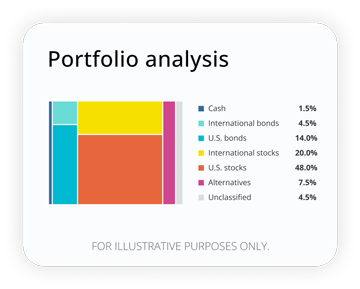
How well are your investments performing?
Analyze your portfolio in minutes and receive a target allocation for your goals.
1 Cerulli and Associates, “Cerulli Anticipates $124 Trillion in Wealth Will Transfer Through 2048,” December 2024.
2 Trust & Will, “Trust & Will 2025 Estate Planning Report,” February 2025.
3 Trust & Will, “Barriers—Why Don’t People Have an Estate Plan?” February 2025.
4 Trust & Will, “Who Has an Estate Plan? A Demographic Breakdown,” February 2025.
5 Trust & Will, “Motivators—What Drives People to Create an Estate Plan,” February 2025.
6 IRS, “Estate Tax Returns Filed for Wealthy Decedents, Filing Years 2013–2022,” Accessed September 2025.
7 CDC, “Mortality in the United States, 2022,” March 2024.
8 Trust & Will, “Motivators—What Drives People to Create an Estate Plan,” February 2025.
9 Trust & Will, “Barriers—Why Don’t People Have an Estate Plan?” February 2025.
10 SHRM, “Estate Planning Benefits Gain Momentum,” September 2023.
11 Ibid.
12 Ibid.
13 Lambergg, “Trust & Will Launches 2025 Estate Planning Report in San Diego, Spotlighting Digital Asset Trusts and Next-Gen Tax Strategies,” May 2025.
RO4801977-0925
 Get The Currency newsletter



The Currency editors
Staff contributors
The CurrencyTM writers and editors cover the latest financial news and insights shaping how we live, work, and play. The team provides accurate, data-driven, and timely content aimed at empowering financial freedom for all.
The content contained in this blog post is intended for general informational purposes only and is not meant to constitute legal, tax, accounting or investment advice. You should consult a qualified legal or tax professional regarding your specific situation. No part of this blog, nor the links contained therein is a solicitation or offer to sell securities. Compensation for freelance contributions not to exceed $1,250. Third-party data is obtained from sources believed to be reliable; however, Empower cannot guarantee the accuracy, timeliness, completeness or fitness of this data for any particular purpose. Third-party links are provided solely as a convenience and do not imply an affiliation, endorsement or approval by Empower of the contents on such third-party websites. This article is based on current events, research, and developments at the time of publication, which may change over time.
Certain sections of this blog may contain forward-looking statements that are based on our reasonable expectations, estimates, projections and assumptions. Past performance is not a guarantee of future return, nor is it indicative of future performance. Investing involves risk. The value of your investment will fluctuate and you may lose money.
Certified Financial Planner Board of Standards Inc. (CFP Board) owns the certification marks CFP®, CERTIFIED FINANCIAL PLANNER™, CFP® (with plaque design), and CFP® (with flame design) in the U.S., which it authorizes use of by individuals who successfully complete CFP Board's initial and ongoing certification requirements.