

How could tariffs impact my wallet and my portfolio? Get a Sense Check
How could tariffs impact my wallet and my portfolio? Get a Sense Check
In this edition of Sense Check, Empower’s Jeff Giannone weighs in on some common questions about tariffs — from whether you should consider adjusting your investment strategy to what steps you can take to stay on track and in control.
How could tariffs impact my wallet and my portfolio? Get a Sense Check
In this edition of Sense Check, Empower’s Jeff Giannone weighs in on some common questions about tariffs — from whether you should consider adjusting your investment strategy to what steps you can take to stay on track and in control.
08.05.2025
Key takeaways
- Tariffs can shake the markets, but reacting to the short-term could do more harm than good
- Even with cooling inflation and steady jobs, tariffs could drive up prices and dent consumer confidence.
- To help navigate uncertainty, investors may want to focus on controllable factors like revisiting goals and risk tolerance.
Tariffs are taxes placed on imported goods, typically with the goal of protecting domestic industries, generating government revenue, and encouraging consumers to purchase local goods rather than items from other countries. They can influence prices on everyday products as well as single-purchase big-ticket items like cars.
As a financial professional, I have been talking about tariffs virtually every day recently, because they’ve been driving the markets. Since February we’ve seen a wave of trade deal renegotiations that have added to market uncertainty and shifting policies and paused tariffs have sparked sharp swings. In early April markets saw their worst week since March 2020, only to bounce back 10% just a few days later when tariff relief was announced.1,2 Beyond the headlines and volatility, tariffs may have a ripple effect on prices, how much you spend, and how you save and invest.
How tariffs could impact your wallet
If there’s an increase in tariffs, then in general we can expect the cost of goods to go up as those increases get passed on to the end consumer. So, people may have to pay more for the regular goods they buy in their daily lives, and we might see faster increases in prices for certain perishable food items that people purchase more regularly.
This can have a wealth effect too: If people see a pullback in the markets — and they have less money — it can ramp up uncertainty and shift confidence. Consumer sentiment might take a hit, and people may think, ‘Okay, I'm going to delay some unnecessary purchases — maybe I don't go on that trip or buy that new car.’
The effect of tariffs on your portfolio
The market volatility we’ve seen from tariff news may be sparking a lot of fluctuation in portfolio values, which not surprisingly, creates uncertainty. As a result, investors may be asking, “Should I change my investment strategy because of tariffs?” The urge to change strategy is natural given the fluctuations that tariffs may be fueling. But I try to remind people that when building a portfolio, look at everything— the big picture, not just how they feel about risk or how old they are — to create a diversified portfolio. And a diversified portfolio generally is doing what it’s designed to do during these times — in other words, a diversification and rebalancing strategy is built to help you weather the storm.*
When I talk with investors I like to give a historical perspective — you know, generally we have a correction roughly every few years on average.3 So, when we see a rapid drop in the value of investments or the market like in April, while it doesn’t always bounce right back, often it does eventually. That’s a good reminder that market fluctuation can’t be timed — and we shouldn’t try by hopping out and then back in a few days later. Tariff-driven volatility is real, but reacting to short-term changes could potentially do more harm than good. It’s important to remember past performance is not a guarantee of future results and investing involves risk, including loss of principal.
Focus on what you can control
With all the noise in the headlines, it can be tough to make measured decisions. But staying focused on the things that are within your control can help you stick to a strategy. Instead of reacting to market swings, there are a few proactive steps you can take.
A good starting point is to revisit the financial planning side of things.
Revisit your financial goals
Ask yourself, ‘What are my goals for this money? Has anything changed?’ This can be a good time to do a financial plan check-in — not a strategy overhaul. It’s important to keep in mind your holistic financial situation as opposed to just looking at a single investment account. Planning and budgeting tools can help you determine whether you’re still on course — despite market noise.
If you still have a high likelihood to achieving your financial objectives even with what’s happening in the short run, this can boost confidence for the long term.
Reassess your risk tolerance
Are you still comfortable with the same level of risk? For example, if you were a moderate investor before, are you still now? If so, are you looking for growth but willing to give up some of that potential return in exchange for more stability?
You can go through a risk assessment questionnaire and find out. It could be that you feel differently about risk today after seeing some volatility than in the past when things were moving upward. Depending on where you are in life, maybe now is the time for you to go from an aggressive risk tolerance to moderate, or moderate to conservative, or vice versa.
Review your cash reserves and emergency fund
If you look at your budget and think, hey, some of these costs are going to go up a bit, then rather than making sudden changes to your investment strategy, think about trying to beef up your rainy-day fund if you’re able. Shoring up cash to have as a safety net can be a good step to help ease stress and provide flexibility during times when you’re feeling some uncertainty, particularly if you’re in a job or industry that could be affected by tariffs.
Final thoughts
Though inflation has eased and employment remains relatively stable, tariff-related uncertainty may prompt people to tighten their belts or even rethink their investment strategy. But trying to time the market, making short-term decisions, or overhauling your investment strategy can backfire. A diversified portfolio can be a way to help absorb shocks like these.
Stay focused on the things you can control: Revisit your goals, reassess your risk tolerance, and review your cash reserves, especially if your income could be affected by supply chain disruptions or cost pressures. Take advantage of tools like budgeting dashboards and retirement planners to help you assess if you’re staying on track amid ongoing tariff developments.
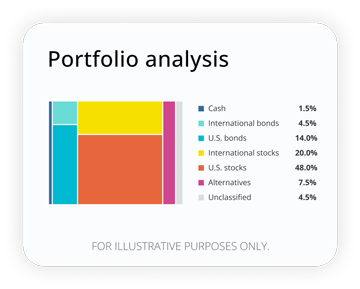
How well are your investments performing?
Analyze your portfolio in minutes and receive a target allocation for your goals.
1 Forbes, “Tariffs Cause Another Stock Market Rout—Losses Approach $5 Trillion As Dow Plummets Another 2,200 Points,” April 4, 2025.
2 Business Insider, “Stocks soar 10% in a stunning rally after Trump pauses trade war,” April 9, 2025.
3 Barrons, “The S&P 500 Is in a Correction. What History Says Happens Next.” March 13, 2025.
* Asset allocation, diversification, or rebalancing does not ensure a profit or protect against loss.
RO4717979-0825
 Get The Currency newsletter


Jeff Giannone
Contributor
Jeff Giannone is a Senior Financial Professional at Empower. He coaches clients to build successful wealth building habits from mindset to successful saving and investing.
The content contained in this blog post is intended for general informational purposes only and is not meant to constitute legal, tax, accounting or investment advice. You should consult a qualified legal or tax professional regarding your specific situation. No part of this blog, nor the links contained therein is a solicitation or offer to sell securities. Compensation for freelance contributions not to exceed $1,250. Third-party data is obtained from sources believed to be reliable; however, Empower cannot guarantee the accuracy, timeliness, completeness or fitness of this data for any particular purpose. Third-party links are provided solely as a convenience and do not imply an affiliation, endorsement or approval by Empower of the contents on such third-party websites. This article is based on current events, research, and developments at the time of publication, which may change over time.
Certain sections of this blog may contain forward-looking statements that are based on our reasonable expectations, estimates, projections and assumptions. Past performance is not a guarantee of future return, nor is it indicative of future performance. Investing involves risk. The value of your investment will fluctuate and you may lose money.
Certified Financial Planner Board of Standards Inc. (CFP Board) owns the certification marks CFP®, CERTIFIED FINANCIAL PLANNER™, CFP® (with plaque design), and CFP® (with flame design) in the U.S., which it authorizes use of by individuals who successfully complete CFP Board's initial and ongoing certification requirements.