

Should I invest in an IPO? How to evaluate the risks
Should I invest in an IPO? How to evaluate the risks
IPOs can be tempting, but investors should exercise caution and weigh the risks before deciding if investing in one fits their strategy
Should I invest in an IPO? How to evaluate the risks
IPOs can be tempting, but investors should exercise caution and weigh the risks before deciding if investing in one fits their strategy

11.05.2026
Key takeaways
- IPO excitement can create an impulse to act quickly, but investors may want to focus on the company, its valuation and the risks rather than the event itself.
- IPO stocks can experience significant price swings, particularly in the period immediately following the IPO.
- Investors may want to consider how an IPO fits into their overall portfolio and remember that they can still choose to invest after the stock begins trading publicly.
Initial public offerings (IPOs) can be hard to resist. A high-profile company goes public. It’s all over the news. Everyone seems to be talking about it. And suddenly, buying shares feels like a chance to get in on the ground floor.
But for many everyday investors, the first opportunity to buy shares may not come until the stock begins trading publicly — and by then, its price may have already moved significantly from the IPO offering price.
But that excitement can come with real risks. Newly public stocks may experience significant volatility, and investors have less public-company history to use when evaluating them. Before investing in an IPO, it can help to look beyond the headlines and consider the company's fundamentals, valuation, and how the investment fits your portfolio and tolerance for risk.
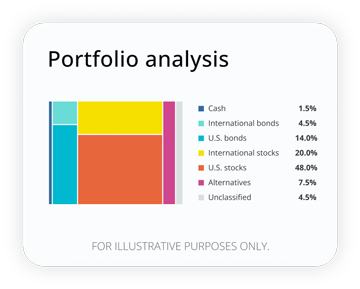
How well are your investments performing?
Analyze your portfolio in minutes and receive a target allocation for your goals.
What are the risks of investing in an IPO?
Investing in an IPO comes with many of the same risks as investing in any individual stock, along with some added uncertainties that can come with a newly public company.
Hype can drive valuations higher
Popular IPOs can attract enormous attention, and that excitement can influence investor demand and the stock’s price. Take SpaceX: Its 2026 IPO was priced at $135 per share, valuing the company at about $1.77 trillion. But estimates of what the shares were worth varied significantly. Morningstar estimated a fair value of $63 per share, 53% below the IPO price.1,2
A great company isn’t necessarily a great investment at any price. Once the initial excitement wears off, investors may focus more on fundamentals such as profits, growth, and whether the company can deliver on expectations. If its financial performance doesn’t support the expectations reflected in its valuation, the stock price could fall.
Investors may want to consider not only whether they believe in the company and its growth potential, but whether that potential is already reflected in the price they’re being asked to pay.
There's less history to evaluate
With an established public company, investors may have years of earnings reports and other public disclosures to review, including information about how management and the business have performed under different market conditions.
A newly public company has less of a public-company track record. Investors can still review historical financial information and other disclosures in its SEC filings, but there's less evidence of how the company will perform and report as a public business.
That limited track record can add uncertainty when investors are trying to determine whether the stock's valuation is justified.
IPO performance can be unpredictable
Newly public stocks can be particularly volatile in the period immediately following an IPO. Their prices may be influenced by investor sentiment, company performance, and broader economic and market conditions.3
Historically, U.S.-listed IPOs have gained about 19% on average from their offering price to the end of their first day of trading, but buying an IPO at the end of its first day and holding it for three years has returned about 21% less on average than a value-weighted market index.4
Early gains aren’t guaranteed to continue, and an IPO’s performance after it begins trading may look very different from its first-day performance.
More shares may become available later
Insiders and early investors are often temporarily restricted from selling their shares following an IPO. When those lockup restrictions expire, some shareholders may choose to sell.
The additional shares becoming available for sale can put downward pressure on the stock price, although a decline isn’t guaranteed.
What should you consider before investing in an IPO?
Weighing whether to invest in an IPO goes beyond evaluating the company itself. It’s also important to consider whether the investment fits your financial goals, time horizon, risk tolerance, and overall portfolio. You may want to consider consulting with a financial professional to assess:
- Your risk tolerance and time horizon: How comfortable are you with potentially significant price swings and losses? A volatile individual stock may not align with a shorter time horizon or money earmarked for near-term needs.
- How the investment fits your portfolio: Would investing in the IPO leave your portfolio overly concentrated in one company, sector, or type of investment? Investing in an individual company introduces company-specific risk. Diversification can help manage concentration risk, although it doesn't guarantee gains or protect against losses.
- The company's fundamentals and valuation: How does the stock’s valuation compare to its growth potential? Before investing, research the company's financial health, business model, growth prospects and major risks. Its prospectus and other SEC filings can provide information about the company's operations, financial condition and potential risks.
Read more: What is risk tolerance and how to determine yours
Should you buy an IPO right away or wait?
The risks associated with investing in IPOs don’t mean that doing so always ends up badly. Some newly public companies go on to become terrific long-term investments. But you don't have to buy on day one to benefit from a great business.
Waiting can give you something valuable: More information and less hype. You'll have time to see how the company performs as a public business, how its financial results develop, and where its stock price settles. When everyone else is worried about getting in early, remember: You don't have to be the first investor in a great company. You’ll want to buy a good investment at a reasonable price.
IPO day isn’t the only opportunity to invest in a company. Investors can generally continue to buy shares on the secondary market after an IPO. And if the company eventually joins a major market index, investors who own funds tracking that index could gain exposure without making an active decision to buy the stock individually.
Still, waiting has tradeoffs. The stock could rise while you wait, and waiting doesn’t guarantee a lower price or eliminate investment risk.
Read more: How to buy an IPO: A step-by-step guide
So, should you invest in an IPO?
Most IPO shares are typically allocated to institutional and high-net-worth investors, while individual investors more commonly buy shares once they begin trading on the public market.5 That means there’s often no need to treat IPO day as a now-or-never opportunity.
Investing in a newly public company ultimately means buying into its vision for the future — and its ability to deliver on the growth and milestones reflected in its valuation. But evaluating the company is only part of the decision. It’s just as important to consider whether the investment fits your own goals, time horizon, risk tolerance, and overall portfolio.
Investing involves risk, including possible loss of principal. Past performance is no guarantee of future results.
1 Bloomberg Law, “SpaceX Seeks $75 Billion in Record IPO to Fund AI, Launch,” June 2026.
2 Morningstar, “SpaceX IPO Deep Dive: The Hype, the Price, and the Opportunity,” June 2026.
3 Investor.gov, “Updated Investor Bulletin: Investing in an IPO,” October 2022.
4 Wall Street Journal, “For a Select Few, IPOs Are Winners. Good Luck to Everyone Else,” June 2026.
5 Investor.gov, “Updated Investor Bulletin: Investing in an IPO,” October 2022.
RO6010706-1026
 Get The Currency newsletter



The content contained in this blog post is intended for general informational purposes only and is not meant to constitute legal, tax, accounting or investment advice. You should consult a qualified legal or tax professional regarding your specific situation. No part of this blog, nor the links contained therein is a solicitation or offer to sell securities. Compensation for freelance contributions not to exceed $1,250. Third-party data is obtained from sources believed to be reliable; however, Empower cannot guarantee the accuracy, timeliness, completeness or fitness of this data for any particular purpose. Third-party links are provided solely as a convenience and do not imply an affiliation, endorsement or approval by Empower of the contents on such third-party websites. This article is based on current events, research, and developments at the time of publication, which may change over time.
Certain sections of this blog may contain forward-looking statements that are based on our reasonable expectations, estimates, projections and assumptions. Past performance is not a guarantee of future return, nor is it indicative of future performance. Investing involves risk. The value of your investment will fluctuate and you may lose money.
Certified Financial Planner Board of Standards Inc. (CFP Board) owns the certification marks CFP®, CERTIFIED FINANCIAL PLANNER™, CFP® (with plaque design), and CFP® (with flame design) in the U.S., which it authorizes use of by individuals who successfully complete CFP Board's initial and ongoing certification requirements.