

U.S. considers portable mortgages to ease housing ‘lock-in’ effect
U.S. considers portable mortgages to ease housing ‘lock-in’ effect
Fannie Mae and Freddie Mac's regulator is studying portable loans that would let homeowners take rates with them when they move
U.S. considers portable mortgages to ease housing ‘lock-in’ effect
Fannie Mae and Freddie Mac's regulator is studying portable loans that would let homeowners take rates with them when they move

11.21.2025

Listen
·U.S. considers portable mortgages to ease housing ‘lock-in’ effect
Key takeaways
- Portable mortgages would let homeowners transfer their existing mortgage and rate to a new property.
- Nearly half (48%) of current mortgage-holders have rates below 4%, according to Empower research.
- Portable loans have never been used in the U.S and would likely require changes to how Fannie and Freddie structure mortgage-backed securities.
The U.S. is studying portable mortgages that could let homeowners carry their existing rate to a new home. The proposal aims to ease the housing market’s “lock-in effect,” which has kept many from selling and moving with current mortgage rates above 6%.
The U.S. housing regulator that oversees Fannie Mae and Freddie Mac is evaluating portable mortgages — loans that would let homeowners carry their existing mortgage rate to a new property.1
The agency hasn’t released details of the review, but the goal is to ease the “lock-in effect” that’s made many homeowners reluctant to sell and move after getting ultra-low mortgage rates during the pandemic era. With 30-year fixed mortgages now in the low-6% range, switching homes often means a more expensive mortgage.2
Only about one in five (21%) mortgage-holders are considering moving or selling their home, according to Empower research. Nearly half of those surveyed (48%) have mortgage rates below 4% while nearly three-quarters (74%) have loans below 6%.
Read more: Mortgage rates and the housing market
How portable mortgages would work
Portable mortgages could provide financial benefits to homeowners who need to move, whether it’s for a job, an expanding family, health reasons, or retirement.3
A portable mortgage would allow a borrower to transfer their existing mortgage and rate to a new property. A borrower selling a $400,000 home with half the balance remaining on a 3% mortgage could move that $200,000 loan to their next home and keep the low rate.4
Transactions might get more complex if the new property costs more than the gains on the old property and the value of the portable mortgage. For a new property costing $450,000, the buyer would need to find an additional $50,000 in cash or take out a second, smaller loan — likely at higher rate.5
Portable mortgages don’t exist in the U.S., but they have been used in other countries like the U.K. and Canada. One reason they work there is that portability is short; borrowers typically have fixed-rate loans lasting only up to five years before they must refinance.6
Potential ripple effects of portable mortgages
It’s unclear how portability would work with longer-term loans such as the 30-year fixed-rate mortgage. Such loans are unique to the U.S. — as are government-backed housing finance companies Fannie Mae and Freddie Mac.7
Fannie and Freddie support about 70% of the U.S. mortgage market by purchasing loans from lenders, bundling them into securities with federal guarantees, and selling them to investors — a process that keeps mortgage credit flowing back to borrowers.8
A potential shift to portable mortgages could impact how mortgage-backed securities (MBS) are structured and priced, along with investor demand and ultimately loan rates. Homeowners typically pay off their existing mortgage in full when they sell their house and move, and prepayment is key dynamic in MBS valuations.9
Some housing finance professionals think portability could make the real estate market more liquid by making it easier for mortgage holders to move, freeing up inventory for new borrowers. Others says the benefits would be selective; first-time homebuyers and other purchasers currently without mortgages would still face today’s rates.10
Read more: Rent vs. buy: The new math in today’s housing market
Buyers find openings in shifting housing market
The combination of elevated mortgage rates and higher home prices — up more than 50% since 2019 — has also prompted Fannie and Freddie’s regulator to examine assumable mortgages. Available on other types of government loans, assumable mortgages are essentially the inverse of portable ones: They allow buyers to take over a seller’s existing mortgage and interest rate — if certain criteria are met.11
While it’s unclear whether these studies will lead to product changes, homebuyers can take some comfort in easing rates. The average 30-year fixed-rate mortgage stands at 6.26%, about half a percentage point lower than at this time last year.12
Buyers looking to move in today’s market have options for potential savings:
- Some are turning to adjustable-rate mortgages (ARMs), which carry risk but include more borrower safeguards than in the past and currently offer initial rates in the mid-5% range.
- A mortgage buydown is another avenue that borrowers can use to temporarily lower the interest rate for the first few years of a home loan. Such breaks are often offered by homebuilders with larger inventories of houses they’re looking to sell.
- Sellers of existing homes have also been more willing to cut deals in recent months, granting more buyer concessions for home repairs, closing costs, inspection fees, and other expenses that come with real estate transactions.
- Borrowers can also actively look for assumable mortgages. Such features can be found on select loans backed by the Federal Housing Administration (FHA), the Department of Veterans Affairs (VA), and others. A borrower would pay the current owner a lump sum for their equity and take over the loan with lender approval.
While it’s too soon to know whether portable mortgages and other new loan options will gain support among lenders and investors, borrowers have ways to manage rates and find a savings edge in today’s market.
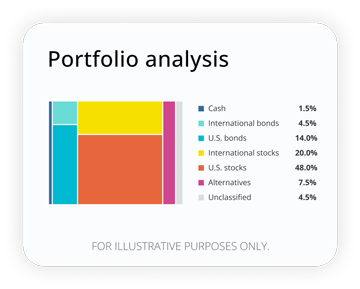
How well are your investments performing?
Analyze your portfolio in minutes and receive a target allocation for your goals.
1 CNN, “The Trump administration is ‘actively evaluating’ portable mortgages. What you need to know,” November 2025.
2 Bloomberg, “Pulte Cites ‘Portable Mortgages’ After 50-Year Idea Panned,” November 2025.
3 Barron’s “2 Mortgage Overhauls That Could Unchain Home Sales,” November 2025.
4 CNN, “The Trump administration is ‘actively evaluating’ portable mortgages. What you need to know,” November 2025.
5 CNN, “The Trump administration is ‘actively evaluating’ portable mortgages. What you need to know,” November 2025.
6 Yahoo! Finance, “Trump administration is 'evaluating' portable mortgages. What that means for homeowners,” November 2025.
7 CNBC, “‘The 30-year fixed-rate mortgage is a uniquely American construct,’ analyst says. Here’s why,” May 2024.
8 FHFA, “About Fannie Mae & Freddie Mac,” accessed November 2025.
9 Realtor.com, “Portable Mortgages Could Break the Housing Market Lock-In—but Do Little for Affordability,” November 2025.
10 Newsweek, “What Portable Mortgages Mean for Housing Market,” November 2025.
11 Barron’s “2 Mortgage Overhauls That Could Unchain Home Sales,” November 2025.
12 Freddie Mac, “Mortgage Rates Show Little Movement,” accessed November 2025.
RO5010289-1125
 Get The Currency newsletter


The Currency editors
Staff contributors
The CurrencyTM writers and editors cover the latest financial news and insights shaping how we live, work, and play. The team provides accurate, data-driven, and timely content aimed at empowering financial freedom for all.
The content contained in this blog post is intended for general informational purposes only and is not meant to constitute legal, tax, accounting or investment advice. You should consult a qualified legal or tax professional regarding your specific situation. No part of this blog, nor the links contained therein is a solicitation or offer to sell securities. Compensation for freelance contributions not to exceed $1,250. Third-party data is obtained from sources believed to be reliable; however, Empower cannot guarantee the accuracy, timeliness, completeness or fitness of this data for any particular purpose. Third-party links are provided solely as a convenience and do not imply an affiliation, endorsement or approval by Empower of the contents on such third-party websites. This article is based on current events, research, and developments at the time of publication, which may change over time.
Certain sections of this blog may contain forward-looking statements that are based on our reasonable expectations, estimates, projections and assumptions. Past performance is not a guarantee of future return, nor is it indicative of future performance. Investing involves risk. The value of your investment will fluctuate and you may lose money.
Certified Financial Planner Board of Standards Inc. (CFP Board) owns the certification marks CFP®, CERTIFIED FINANCIAL PLANNER™, CFP® (with plaque design), and CFP® (with flame design) in the U.S., which it authorizes use of by individuals who successfully complete CFP Board's initial and ongoing certification requirements.