

Giving back hits $592.5 billion: How to choose a charity to maximize impact
Giving back hits $592.5 billion: How to choose a charity to maximize impact
Doing due diligence on an organization’s purpose and results can help donors make every dollar count
Giving back hits $592.5 billion: How to choose a charity to maximize impact
Doing due diligence on an organization’s purpose and results can help donors make every dollar count

12.10.2025

Listen
·Giving back hits $592.5 billion: How to choose a charity to maximize impact
Key takeaways
Charitable giving in the U.S. reached a high at over $592 billion in 2024
More than 1.8 million charitable organizations exist in the U.S. with 501(c)(3) tax-exempt status
Understanding an entity’s mission, purpose, and results can help donors maximize giving power
Giving Tuesday donations rose to $4 billion in 2025 to kick off the giving season
Not all charities operate the same way, so a bit of research can help ensure donations truly make an impact. Understanding the differences between nonprofits and not-for-profits, reviewing mission alignment, evaluating transparency, and assessing measurable results all help donors make informed decisions. Confirming tax status and exploring strategic giving options can further maximize the effect of charitable contributions.
With more than 1.8 million charitable organizations in the U.S., choosing where to direct philanthropy can take some research.1 Not all charities are created equal, so understanding how an organization will use the funds can help ensure donations have the most impact.
Giving on the rise
Charitable giving increased in 2024, with philanthropic donations to U.S. charities reaching a record $592.5 billion, and that upward trend could continue.2 Peak giving season kicked off strong, with donations on Giving Tuesday hitting an estimated $4 billion this year, up from $3.6 billion in 2024 — an encouraging indicator for how the rest of the season will go.3 And with sweeping tax changes as a result of the One Big Beautiful Bill Act, many more may be inspired to give: Beginning in 2026, some 144 million Americans who take standard deductions on their income taxes will be eligible to deduct charitable contributions (up to $1,000 for individuals filers and $2,000 for joint filers).
As giving grows, donors face a more complex landscape — and distinguishing between different types of charitable entities can be key.
Distinguishing between nonprofit and not-for-profit
The terms “nonprofit” and “not-for-profit” are often used interchangeably, but there are some nuances. Understanding the difference is important for donors to help ensure they’re giving to the type of organization that best aligns with their intentions.
Nonprofit organizations operate with a legally recognized mission or social purpose, rather than a goal of generating profit. They’re typically overseen by a board of directors, and any revenue they earn is reinvested into their programs and not distributed to shareholders. Many hospitals, universities, national charities, and foundations fall under this category — tax-exempt under section 501(c)(3) of the Internal Revenue Code.4,5
Not-for-profit organizations (NFPOs) differ in purpose and scope from nonprofits. NFPOs typically focus on benefiting a specific group rather than the general public — for example, recreational clubs, parent-teacher associations, and social organizations. They can still accept donations, but their purpose is typically narrower. Like nonprofits, they generate revenue through external sources like donations and grants (NFPOs might have membership dues) and reinvest any profit back into the organization. However, while they may qualify for some tax benefits, typically they don’t qualify for a full tax exemption like a nonprofit.6
Read more: Charitable giving: Tax-smart strategies for doing good
Aligning goals and mission
For many donors it may be important to find a charitable organization whose goals and mission support what matters most to them. Reviewing a charity’s mission statement can shed light on the specific purpose the entity serves and the issues it tackles, along with its geographic focus, long-term goals, and other insights. A clear, well-defined mission can be a good sign of a focused and effective organization.
Read more: “Giving while living” can help build generational wealth
Identifying how the charity allocates resources
Charitable organizations need administrative support and fundraising and often have other overhead expenses to operate efficiently. But it’s important to understand if the group will manage donations and programs effectively. As part of due diligence, look at whether the charity:
- Clearly breaks down spending across programs — what portion of resources is allocated to administration and fundraising versus funding the activities and causes at the heart of the organization’s mission?
- Provides access to IRS Form 9907
- Is transparent about how it allocates resources and why
If an organization avoids sharing financial details or seems vague about how donations are used, that could be a potential red flag.
Evaluating the charity’s impact
While many organizations can clearly articulate goals, not all can demonstrate how their work leads to measurable results. For donors, evaluating impact means looking beyond mission statements and asking how the organization proves its value.
An effective charity will likely track outcomes and measure results. Look for annual reports outlining progress toward goals, and data points showing what has changed and how donations have translated into tangible improvements. Independent assessments can also provide useful clarity. Platforms such as Charity Navigator, GuideStar, and the BBB Wise Giving Alliance can be useful resources to help evaluate entities based on transparency, financial health, and evidence of results.8,9,10
Making donations count
Choosing a charity is an important step, but developing a holistic giving-back strategy can be an important part of a comprehensive financial plan. Bunching strategies, donor-advised funds, and gifting assets other than cash such as publicly traded securities are just a few options to consider for optimizing giving power. Additionally, before donating, it’s essential to verify a charity’s 501(c)(3) status if tax deductions are a priority.
Read more: 144 million Americans may soon get a new tax break for charitable donations
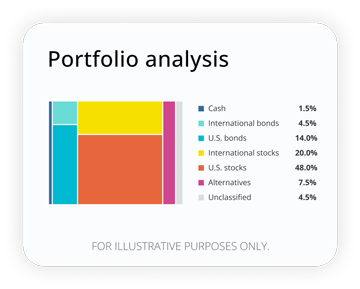
How well are your investments performing?
Analyze your portfolio in minutes and receive a target allocation for your goals.
1 National Philanthropic Trust, “Charitable Giving Statistics,” December 2025.
2 Giving USA, “U.S. charitable giving grew to $592.50 billion in 2024, lifted by stock market gains,” June 24, 2025.
3 AP, “Americans gave $4B on Giving Tuesday 2025 as donations and volunteering gain big over last year,” December 3, 2025.
4 U.S. Chamber of Commerce, “Nonprofit vs. Not-for-Profit vs. For-Profit: What's the Difference?” March 17, 2025.
5 Internal Revenue Service, “Exemption requirements - 501(c)(3) organizations,” August 20, 2025.
6 Internal Revenue Service, “Tax Exempt Organization Search” August 20, 2025.
7 Internal Revenue Service, “About Form 990, Return of Organization Exempt from Income Tax,” January 30, 2025.
8 Charity Navigator, “Search for Charities,” December 2025.
9 GuideStar, “Providing you with the nonprofit information you need,” December 2025.
10 BBB Wise Giving Alliance, “Find Charities You Can Trust,” December 2025.
RO5050365-1225



 Get The Currency newsletter
The Currency editors
Staff contributors
The CurrencyTM writers and editors cover the latest financial news and insights shaping how we live, work, and play. The team provides accurate, data-driven, and timely content aimed at empowering financial freedom for all.
The content contained in this blog post is intended for general informational purposes only and is not meant to constitute legal, tax, accounting or investment advice. You should consult a qualified legal or tax professional regarding your specific situation. No part of this blog, nor the links contained therein is a solicitation or offer to sell securities. Compensation for freelance contributions not to exceed $1,250. Third-party data is obtained from sources believed to be reliable; however, Empower cannot guarantee the accuracy, timeliness, completeness or fitness of this data for any particular purpose. Third-party links are provided solely as a convenience and do not imply an affiliation, endorsement or approval by Empower of the contents on such third-party websites. This article is based on current events, research, and developments at the time of publication, which may change over time.
Certain sections of this blog may contain forward-looking statements that are based on our reasonable expectations, estimates, projections and assumptions. Past performance is not a guarantee of future return, nor is it indicative of future performance. Investing involves risk. The value of your investment will fluctuate and you may lose money.
Certified Financial Planner Board of Standards Inc. (CFP Board) owns the certification marks CFP®, CERTIFIED FINANCIAL PLANNER™, CFP® (with plaque design), and CFP® (with flame design) in the U.S., which it authorizes use of by individuals who successfully complete CFP Board's initial and ongoing certification requirements.