

Could a scammer convince you to empty your retirement account?
Could a scammer convince you to empty your retirement account?
How to recognize the warning signs of common financial scams and help protect your retirement savings
Could a scammer convince you to empty your retirement account?
How to recognize the warning signs of common financial scams and help protect your retirement savings

10.20.2026
Key takeaways
- Scams are becoming commonplace in everyday life, with 91% of Americans having encountered a cyberattack or digital scam attempt.
- Americans reported losing $3.5 billion to imposter scams in 2025, as scammers used tactics like fear, trust, and urgency to manipulate financial decisions.
- Recognizing the red flags, independently verifying requests, and securing your accounts can help protect your retirement savings.
Imagine trusting someone you met online with your future, only to discover they've been manipulating you into handing over your life savings. What started as a promising relationship becomes an investment opportunity, with impressive returns encouraging you to put in more money. Eventually, you're withdrawing from retirement accounts you've spent decades building. By the time you realize it's a scam, the money is gone.
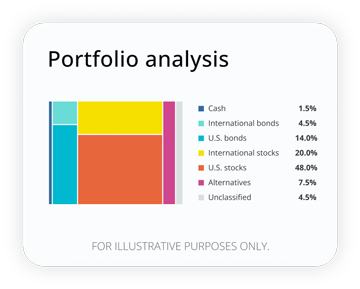
How well are your investments performing?
Analyze your portfolio in minutes and receive a target allocation for your goals.
That's what happened to Jackie Crenshaw, who lost approximately $900,000 to a romance and cryptocurrency investment scam, including $40,000 withdrawn from her 401(k).1
It's easy to hear a story like hers and think, I'd never fall for that. But scams can happen to anyone, regardless of age or financial experience. Romance scams are just one way criminals manipulate people into handing over their money. Others impersonate banks, businesses, or government officials, sometimes threatening arrest or claiming an account has been compromised. While the scenarios differ, the tactics often rely on the same emotions: fear, trust, and urgency.
Scams are growing in scale
Americans reported losing $3.5 billion to imposter scams in 2025 alone, according to the Federal Trade Commission.2 And reports of six-figure losses to business and government impersonation scams among adults 60 and older increased nearly sevenfold between 2020 and 2024.3
Artificial intelligence is adding another layer of sophistication. Scammers can use AI to create realistic voices, videos, fake identities, and convincing messages that appear to come from trusted sources. In 2025, the FBI received more than 22,000 complaints involving AI, with nearly $893 million in reported losses.4
With 91% of Americans having encountered a cyberattack or digital scam attempt, recognizing the warning signs could be the difference between protecting your retirement savings and handing them over to a scammer.5
The most common financial scams
Financial scams take many forms, from convincing people to send money to gaining unauthorized access to their accounts. Some common types include:
- Imposter scams: Criminals pose as banks, businesses or other trusted organizations, claiming there's suspicious activity on your account, an unauthorized purchase or a security problem. They may ask you to share personal information or transfer money to a supposedly safe account.
- Government impersonation scams: Someone claiming to be a government official or law enforcement agent warns that your identity has been linked to a crime or that you're facing arrest. They may demand payment or instruct you to move money to resolve the supposed problem.
- Romance scams: Fraudsters build relationships online, sometimes over weeks or months, before requesting money or introducing fraudulent investment opportunities. These scams often rely on emotional trust rather than immediate pressure.
- Phishing and account hacking: Fraudulent emails, texts, or websites trick people into clicking malicious links or revealing login credentials. Once scammers gain access to an account, they may steal personal information, impersonate trusted contacts, or attempt unauthorized transactions.
Scams change. The red flags don’t
Scammers may use different stories and increasingly convincing technology, but many of the warning signs remain the same. Be cautious when someone:
🚩 Appears to be someone you trust: Claims to represent a family member, employer, financial institution or government agency.
🚩 Requests unusual payments: Asks for money through cryptocurrency, gift cards, wire transfers, or payment apps.
🚩 Asks for sensitive information: Requests passwords, security codes, or personal details they shouldn't need.
🚩 Creates pressure or secrecy: Insists you act immediately or keep the conversation confidential.
How one saver avoided a $400,000 scam Unbeknownst to him, cybercriminals had gained access to his email account and blocked incoming messages from several business partners. They then sent a fraudulent email impersonating one of his vendors, complete with instructions to wire nearly $400,000 to a bank account. The email looked legitimate, but the payment instructions didn't match the vendor's usual process. Something wasn't right. Rather than sending the money, he paused and contacted his business partner directly to verify the request. The vendor confirmed the email was fraudulent, and that extra step helped protect nearly $400,000 from being sent to cybercriminals. While the scammer was not targeting the customer’s accounts at Empower, he credits Empower cybersecurity information for helping him spot red flags. |
How to help protect your savings
Recognizing the warning signs is important, but a few simple habits can also help protect your money and personal information.
- Pause: Stop before clicking links, sharing information, or sending money in response to an unexpected request. Don't let urgency make the decision for you.
- Verify: Contact the person or organization using a phone number, website, or contact you already trust, rather than information provided in a suspicious message.
- Protect: Register and regularly monitor your financial accounts. Use long, unique passwords, enable multifactor authentication (MFA), protect your email and phone, and keep your contact information up to date.
If you suspect fraud: Act quickly. Contact Empower and any affected financial institutions, secure your accounts, and review recent activity for unauthorized transactions or changes. If your email or device may be compromised, use a different trusted device to update your passwords. Consider a credit freeze or fraud alert if your personal information has been exposed and continue monitoring your accounts.
For more information on protecting your accounts, visit the Empower Security Center.
1 Business Insider, “I was preparing for retirement — then I lost $900,000 in a romance scam,” June 2026.
2 Federal Trade Commission, “FTC Data Show People Reported Losing $3.5 Billion to Imposter Scams in 2025,” June 2026
3 Federal Trade Commission, “False alarm, real scam: how scammers are stealing older adults’ life savings,” August 2025.
4 FBI, “Internet Crime Report 2025, ” April 2026.
5 Consumer Reports, “Scams are part of everyday American life,” October 2026.
RO6020190-1026
 Get The Currency newsletter




The Currency editors
Staff contributors
The CurrencyTM writers and editors cover the latest financial news and insights shaping how we live, work, and play. The team provides accurate, data-driven, and timely content aimed at empowering financial freedom for all.
The content contained in this blog post is intended for general informational purposes only and is not meant to constitute legal, tax, accounting or investment advice. You should consult a qualified legal or tax professional regarding your specific situation. No part of this blog, nor the links contained therein is a solicitation or offer to sell securities. Compensation for freelance contributions not to exceed $1,250. Third-party data is obtained from sources believed to be reliable; however, Empower cannot guarantee the accuracy, timeliness, completeness or fitness of this data for any particular purpose. Third-party links are provided solely as a convenience and do not imply an affiliation, endorsement or approval by Empower of the contents on such third-party websites. This article is based on current events, research, and developments at the time of publication, which may change over time.
Certain sections of this blog may contain forward-looking statements that are based on our reasonable expectations, estimates, projections and assumptions. Past performance is not a guarantee of future return, nor is it indicative of future performance. Investing involves risk. The value of your investment will fluctuate and you may lose money.
Certified Financial Planner Board of Standards Inc. (CFP Board) owns the certification marks CFP®, CERTIFIED FINANCIAL PLANNER™, CFP® (with plaque design), and CFP® (with flame design) in the U.S., which it authorizes use of by individuals who successfully complete CFP Board's initial and ongoing certification requirements.