

Saying “I do” to separate finances
Saying “I do” to separate finances
More couples are moving away from merging money as a way to reduce stress, preserve independence, and still support shared goals
Saying “I do” to separate finances
More couples are moving away from merging money as a way to reduce stress, preserve independence, and still support shared goals

01.30.2026

Listen
·Saying “I do” to separate finances
Key takeaways
- 23% of couples do not have any joint bank accounts.
- Nearly 4 in 5 couples married 9-13 years have joint accounts.
- For couples keeping money separate, it’s important to agree up front about how shared expenses, emergencies, and windfalls will be handled.
For generations, the conventional wisdom around marriage and long-term partnerships was simple: Combine everything. Joint checking accounts, shared credit cards, and fully merged financial lives were typically seen as symbols of unity. But today, many couples are rethinking this tradition.
Money can be an emotionally charged topic — in fact, Empower research reveals 37% of people in a relationship say finances are the biggest stressor. Many couples are finding merit in keeping some or all of their money separate, to reduce conflict and preserve financial independence.
According to the latest U.S. Census data, nearly one in four couples (23%) do not have any joint bank accounts, up from 15% in 1996, and 17% of couples have a combination of shared and separate accounts.1 Two in five couples (40%) hold all of their bank accounts jointly.2
The length of relationships and factors like having children may influence the decision to combine finances: 79% of couples married for 9-13 years hold joint bank accounts, while 68% of those married 4-8 years do.3
Why some couples choose separate finances
Keeping finances separate doesn’t necessarily signal a lack of commitment. In fact, for many couples it’s a proactive strategy with potential benefits, including fewer arguments over spending habits, clearer accountability, and a greater sense of independence — particularly for those who enter relationships with different incomes, debt levels, or financial priorities.
Communication is critical for couples considering separate finances. And before making the decision, they should agree on some core issues:
How to cover joint expenses
Even when opting for separate finances, you may still need to find a way to split some of the costs of everyday life. One common approach is to have a joint account for shared expenses like housing, utilities and other bills, groceries, and childcare, with each partner contributing regularly. Couples might choose to contribute equally or based on income if earnings differ. It’s important to establish up front which expenses are considered shared, and how each partner intends to pay them to keep shared spending predictable and as low-stress as possible. Conversations should also cover handling shared discretionary expenses like vacations.
How to handle taxes
Married couples who manage money separately still face the decision of whether to file taxes jointly or separately. While filing separately may be advantageous in select cases, it can also come with trade-offs, including reduced eligibility for certain credits and deductions. Additionally, filing separately could potentially result in a less favorable tax bracket.
Read more: How married filing separately works and when to do it
How to deal with a windfall
Inheritances, bonuses, or other unexpected financial gains can create tension if expectations aren’t aligned ahead of time. Empower research shows that 65% of Americans say they’d save or invest a windfall and 52% would use it to reduce debt. Some couples choose to treat windfalls as individual assets, while others decide to allocate a portion toward shared goals like paying down debt, building savings, or funding a vacation or future purchase. Talking through these scenarios in advance can help avoid misunderstandings later and make it easier to respond thoughtfully when extra money enters the picture.
Read more: What would Americans do with a windfall?
How to manage emergency expenses
According to Empower research, one third of Americans (32%) don’t have an emergency savings fund and 29% say they can’t afford an unexpected expense over $400. For couples with separate finances, that makes it especially important to decide in advance how they’ll handle unplanned costs like medical bills, car repairs, or urgent home fixes. Some partners build a shared emergency fund for joint expenses, while others keep individual savings but agree on when and how they’ll step in for shared needs — helping reduce panic and pressure when the unexpected happens.
Read more: The Safety Net: Americans have $500 in emergency savings
How to meet shared goals
Keeping finances separate doesn’t mean planning for the future separately. Big-picture goals — like buying a home, saving for retirement, or funding a child’s education — still require coordination and clarity. Many couples find it helpful to talk openly about timelines, priorities, and how much each person can realistically contribute, even if the money itself stays in individual accounts. Regular check-ins can help ensure partners are moving in the same direction and adjusting for life changes.
Other considerations
A prenuptial agreement may be a useful option for couples who are planning to marry and keep their finances separate. Roughly 1 in 5 married couples have a prenup and half of Americans say they’re open to using them. These legal agreements can clarify expectations, protect individual assets, and reduce uncertainty — especially when finances are kept separate — if a marriage ends, either in divorce or death of a spouse. While not required, prenups state how assets will be divided — and can dictate the treatment of debt acquired individually and as a couple during the marriage.
Along with maintaining open, clear lines of communication, couples who decide to keep finances separate may want to consult with a financial professional.
Read more: Do I need a prenuptial agreement? What to know before marriage
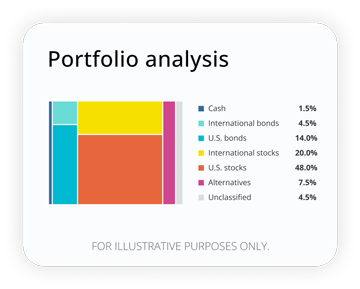
How well are your investments performing?
Analyze your portfolio in minutes and receive a target allocation for your goals.
1 U.S. Census Bureau, “Almost a Quarter of Married Couples Didn’t Have Joint Accounts in 2023, Up From 15% in 1996,” September 24, 2025.
2 Ibid.
3 Ibid.
RO5167604-0126
 Get The Currency newsletter
News and know-how for whatever money decision comes next.
*If you’re already registered with Empower, please use the same email address as your existing account.

The Currency editors
Staff contributors
The CurrencyTM writers and editors cover the latest financial news and insights shaping how we live, work, and play. The team provides accurate, data-driven, and timely content aimed at empowering financial freedom for all.
The content contained in this blog post is intended for general informational purposes only and is not meant to constitute legal, tax, accounting or investment advice. You should consult a qualified legal or tax professional regarding your specific situation. No part of this blog, nor the links contained therein is a solicitation or offer to sell securities. Compensation for freelance contributions not to exceed $1,250. Third-party data is obtained from sources believed to be reliable; however, Empower cannot guarantee the accuracy, timeliness, completeness or fitness of this data for any particular purpose. Third-party links are provided solely as a convenience and do not imply an affiliation, endorsement or approval by Empower of the contents on such third-party websites. This article is based on current events, research, and developments at the time of publication, which may change over time.
Certain sections of this blog may contain forward-looking statements that are based on our reasonable expectations, estimates, projections and assumptions. Past performance is not a guarantee of future return, nor is it indicative of future performance. Investing involves risk. The value of your investment will fluctuate and you may lose money.
Certified Financial Planner Board of Standards Inc. (CFP Board) owns the certification marks CFP®, CERTIFIED FINANCIAL PLANNER™, CFP® (with plaque design), and CFP® (with flame design) in the U.S., which it authorizes use of by individuals who successfully complete CFP Board's initial and ongoing certification requirements.